Best Backpack Leaf Blower for Big Fall Cleanups

Five gas backpack blowers compared on published weight, engine size and warranty, with the Husqvarna 150BT taking the top spot and a lighter 17 lb alternative for anyone who dreads the harness.

By Eli DixonUpdated 15 min read
On this page
- Best backpack leaf blower for large yards at a glance
- How I ranked these five backpack blowers
- Why CFM is the wrong number to shop on
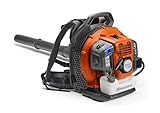
- 1. Husqvarna 150BT Gas Backpack Leaf Blower — Best overall
- 2. Thalorus 52cc Backpack Leaf Blower — Best for beginners
- 3. Getell 63CC Gas Backpack Leaf Blower — Best for heavy use
- 4. PROYAMA 72CC Gas Backpack Leaf Blower — Runner-up
- 5. VEVOR 63CC Backpack Leaf Blower Gas Powered — Best budget pick
- How much does harness weight actually matter?
- What does a big yard really demand from a blower?
- What the listings leave out
- The verdict
- FAQ
The best backpack leaf blower for large yards is the Husqvarna 150BT, because it pairs a named 51-cc 2-cycle engine with a 2-year warranty on a 22 lb frame. If that weight sounds like too much on your shoulders, the 17 lb Thalorus 52cc is the lighter alternative. Engine size is what splits this field, and it splits it strangely: displacement here runs from 51cc to 72cc, and the biggest engine is not attached to the biggest airflow claim. That gap is the whole story.
Best backpack leaf blower for large yards at a glance
| Pick | Engine | Weight | Price |
|---|---|---|---|
Best overall Husqvarna 150BT Gas Backpack Leaf Blower |
51-cc, 2.16-HP 765 CFM claim |
22 lb | Check Price |
Best for beginners Thalorus 52cc Backpack Leaf Blower |
52cc 550 CFM claim |
17 lb | Check Price |
Best for heavy use Getell 63CC Gas Backpack Leaf Blower |
63cc 665 CFM claim |
23.1 lb | Check Price |
| 72cc dual-tube design |
21 lb | Check Price | |
Best budget pick VEVOR 63CC Backpack Leaf Blower Gas Powered |
63cc 1110 CFM claim |
26.5 lb | Check Price |


How I ranked these five backpack blowers
I weighted three things, in this order.
- Published, verifiable specifications. Weight, dimensions, warranty and model number are standardised. I gave them the most weight because they are the only figures on a listing that a manufacturer cannot spin.
- Warranty term. Three of these five publish one. That is a meaningful split in a category full of 2-cycle engines that will eventually need a carburetor rebuild.
- Engine displacement. A stated cc figure is more comparable than an airflow claim, because displacement is a physical measurement and CFM depends on how the maker chose to test it.
Airflow claims came last, and only as attributed marketing copy. That ordering is why the 51-cc Husqvarna sits above a 72CC machine: displacement is one input, and a documented warranty plus a named engine design carries more real risk reduction than 21 extra cubic centimetres on a spec sheet.
Nothing was cut for being cheap. The cheapest pick here made the list. What I did downgrade was any pick with no published warranty term, because that is the single field a buyer of a gas backpack leaf blower for large yards will care about in year three.
Why CFM is the wrong number to shop on
Look at this group and the problem is obvious. The VEVOR claims 1110 CFM. The Thalorus claims 550 CFM. The VEVOR's stated engine is 63cc, the Thalorus 52cc. An 11cc difference in displacement producing double the airflow is not a physical result, it's two different measurement methods printed as though they were the same.
There is no shared standard forcing every brand to measure at the same point in the tube. Measure at the housing, before the nozzle narrows the stream, and the number climbs. Measure at the nozzle tip and it drops. The buyer cannot tell which one they're reading.
So use CFM the way I do: as a rough tier marker, never as a tiebreaker between two picks. What actually decides a big fall cleanup is whether you can keep the machine on your back for 40 minutes. Here's the trick with the best backpack leaf blower for large yards. Displacement tells you the ceiling. Weight tells you how much of that ceiling you'll actually use before you set it down.
What to trust, in order:
- Weight in pounds, because it's measured the same way everywhere
- Engine displacement in cc, a physical dimension
- Warranty term in years, a contractual commitment
- Dimensions, useful for shelf and vehicle planning
- Airflow claims, treated as the manufacturer's claim
1. Husqvarna 150BT Gas Backpack Leaf Blower — Best overall
The 150BT is the pick I'd hand to almost any homeowner, because it's the only one here backed by a named engine design and a 2-year warranty from a brand that has been building 2-cycle equipment for decades.
Best for: homeowners who want a named engine and a published warranty Skip it if: you want the lowest price in this group
This is the most expensive pick here, and it's also the one buyers choose most often in this set by a wide margin. Those two facts together tell you something. Husqvarna lists a 51-cc, 2.16-HP engine and calls it X-TORQUE, and quotes 765 CFM, 270 MPH and 22 N of blowing force. Treat those as the manufacturer's figures. What I can verify is the frame around them: 22 lb, 14 x 18 x 11 in, model 970466901, and a 2-year warranty.
That 14 x 18 x 11 in footprint is the most compact of all five. The others range up to 22 in on their longest listed side. If your blower lives on a garage shelf between October and December, that difference is real.
Husqvarna describes a padded harness with a hip belt and a weight-levelling load management system. On a 22 lb unit, a hip belt matters more than padding does, because it moves load off your shoulders and onto your pelvis.
The trade-off is displacement. At 51-cc it's the smallest engine of the five, and you pay the most for it. You're buying documentation and brand support, not raw cubic centimetres.
Pros:
- Smallest listed footprint at 14 x 18 x 11 in
- Named 2-year warranty
- Hip belt and load-levelling harness described
- The one buyers choose most often here
- Full model number published for parts lookup
Cons:
- Smallest engine displacement in this group at 51-cc
- The most expensive pick here
- Only two sellers list it
- At 22 lb, heavier than two cheaper picks
2. Thalorus 52cc Backpack Leaf Blower — Best for beginners
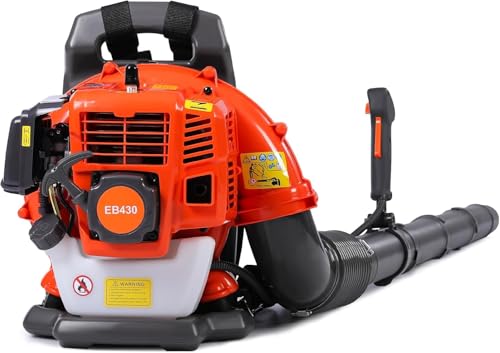
At 17 lb, the Thalorus is 9.5 lb lighter than the heaviest pick here, and that single figure is why I'd point a first-time buyer at it.
Best for: first-time backpack blower buyers who dread the weight Skip it if: you need the biggest engine here
Nine and a half pounds is a lot of difference to carry. The Thalorus lists at 17 lb, the second-cheapest of the five, with a 2-year manufacturer warranty. Its listing quotes 550 CFM and 230 MPH from the 52cc engine, a 1-litre tank, up to 45 minutes of runtime, and a two-pull start. Those are Thalorus's claims. The listing also refers to 13.6 lbs in one bullet while the specification says 17 lb, and when a listing contradicts itself I go with the specification field.
Note the 68.9 in listed dimension. That is the tube assembly length, not a body measurement, and it's worth knowing before you plan storage.
The 52cc engine sits second-smallest here, and 550 CFM is the lowest airflow claim in the set. So this is not the machine for a five-acre property covered in soaked oak leaves. For a half-acre with a driveway and some beds, the lighter harness will do more for your Saturday than 100 extra claimed CFM would.
Against the Husqvarna, it gives up a named engine design and a brand parts network. It gains a warranty on equal terms and takes 5 lb off your back.
Pros:
- Lightest in this set at 17 lb
- 2-year manufacturer warranty published
- Second-cheapest pick here
- Cruise control and thumb throttle described
- 1-litre tank and 45-minute runtime claimed
Cons:
- Lowest airflow claim of the five at 550 CFM
- Listing weight figures contradict each other
- Second-smallest engine at 52cc
- Model field is just the brand name, so parts lookup is vague
3. Getell 63CC Gas Backpack Leaf Blower — Best for heavy use
The Getell GB657 PRO is the pick I'd choose for long sessions, because it's the only one that describes a commercial-grade 2-stage air filter with tool-free access alongside its cruise control.

Best for: long sessions where a locked throttle saves your thumb Skip it if: you want the lightest harness in this set
Getell lists 63cc, 665 CFM and 205 MPH, plus a 2-stage air filter, vibration reduction, cooling ventilation and a 3-to-8 pull start. Verified: 23.1 lb, 21.2 x 17.7 x 14.1 in, model GB657 PRO, and a 2-year manufacturer warranty. That warranty puts it in the same tier as the Husqvarna and Thalorus, and it sits roughly mid-range for price here.
Air filtration deserves more attention than it gets. Blowing dry leaves generates dust that goes straight into the intake, and a clogged filter starves the engine long before anything breaks. Getell says the filter opens without tools. That's the kind of small detail that decides whether maintenance actually happens.
Cruise control is the other reason this pick earns its award. Holding a trigger at three-quarters throttle for 40 minutes is what wrecks your thumb, not the weight. Locking the RPM and steering with your hand free is a genuine comfort gain on a big property.
The cost is weight and momentum. At 23.1 lb it's the second-heaviest here, and it's the slowest seller of the five, which usually means less community knowledge to lean on when something goes wrong.
Pros:
- 2-year manufacturer warranty published
- 2-stage air filter with tool-free access described
- Cruise control frees your throttle hand
- Full model number GB657 PRO for parts
- Mid price position rather than premium
Cons:
- Second-heaviest at 23.1 lb
- The slowest seller of the five
- Airflow claim below two cheaper picks
- Vibration reduction described but not quantified
4. PROYAMA 72CC Gas Backpack Leaf Blower — Runner-up
PROYAMA brings the biggest engine here, 72CC, on a 21 lb frame, which is an unusual pairing worth a hard look.

Best for: buyers who want the largest engine and two nozzle shapes Skip it if: you want a published warranty term
Twenty-one pounds with a 72CC engine is the standout number in this whole comparison. The Husqvarna carries 22 lb around a 51-cc engine. That is 21 more cubic centimetres of displacement on a pound less of listed weight. If displacement is what you're shopping for, this is the pick.
PROYAMA calls it commercial-grade and describes a dual-tube design with both flat and round nozzles, shock-absorbing straps, a self-throttle lock, variable speed throttle and cruise control. Those are the maker's claims. The flat nozzle is genuinely useful and the others don't mention one. A flat tip narrows the stream and lifts wet debris off pavement better than a round tip does.
Verified specifications are thinner: 21 lb, 22 x 18 x 14.5 in, model PBB72, Black. There is no warranty term published and no airflow figure completed in the listing copy, which cuts off mid-sentence at "delivers 3." The 22 in dimension also makes it the longest listed body here.
That thin documentation is why it's the runner-up and not the winner. Only one seller lists it, and it's the second-most expensive pick, which is a lot to spend without a stated warranty.
Pros:
- Largest engine in this group at 72CC
- Second-lightest listed weight at 21 lb
- Only pick with both flat and round nozzles
- Self-throttle lock and cruise control described
Cons:
- No warranty term published
- No complete airflow figure in the listing
- Only one seller lists it
- Longest listed body at 22 in
- Second-highest price position here
5. VEVOR 63CC Backpack Leaf Blower Gas Powered — Best budget pick
The VEVOR is the cheapest of the five and ships with the most complete accessory kit, including earmuffs, which nobody else here mentions.

Best for: spending the least while getting a full accessory kit Skip it if: you plan to carry it for an hour straight
Read the accessory list carefully, because it's the real selling point. VEVOR includes noise-reducing earmuffs, a corrugated tube, a main air tube, an extension tube, a flat nozzle, two clamps, a socket wrench, an open wrench and a Philips driver. A 2-cycle engine near your ear needs hearing protection, and having it in the box removes a purchase you'd otherwise forget.
The listing quotes 63cc, 1110 CFM, 220 MPH and a 1.89L tank. That 1110 CFM is the highest claim here by a margin of 345 over the next pick, which is exactly the kind of number I'd treat as measured differently rather than measured better. The 1.89L tank is the largest stated fuel capacity in this comparison.
Now the catch: 26.5 lb. That's the heaviest of the five and 9.5 lb more than the Thalorus. VEVOR describes a shock-absorption system and high-strength nylon straps, but no hip belt appears in the copy, and on a 26.5 lb load a hip belt is what your shoulders would want.
There's no published warranty term either. Cheapest price, heaviest frame, no stated warranty. Know what you're accepting.
Pros:
- The cheapest of the five
- Largest stated tank at 1.89L
- Earmuffs and a full tool kit included
- Adjustable hose angles described
- Flat nozzle included in the box
Cons:
- Heaviest here at 26.5 lb
- No published warranty term
- No hip belt described in the harness
- Airflow claim of 1110 CFM is an outlier
- Only one seller lists it
How much does harness weight actually matter?
More than anything else on the spec sheet. The spread here runs from 17 lb to 26.5 lb, which is a 9.5 lb difference, and that difference compounds with every minute you wear it.
Think about how a large property actually gets cleared. You're not standing still. You're walking a perimeter, pivoting, stepping over beds, going up and down a slope. Every one of those movements costs more with a heavier pack, and the cost isn't linear. It builds.
Here's the practical test I'd apply. Fill a backpack with bags of flour to match the weight you're considering, put it on, and walk your yard once. If you'd rather stop at the halfway point, the engine size is irrelevant.
Where each pick lands:
- 17 lb, Thalorus: manageable for most adults through a full cleanup
- 21 lb, PROYAMA: fine for 30 to 40 minutes with a decent harness
- 22 lb, Husqvarna: a hip belt is described, which changes the arithmetic
- 23.1 lb, Getell: cruise control offsets some of the fatigue
- 26.5 lb, VEVOR: plan on breaks, and check the strap adjustment carefully
Harness design partially cancels weight. A hip belt shifts load to your hips, where your skeleton carries it, instead of hanging it off your shoulders. Of these five, only the Husqvarna listing names a hip belt.
What does a big yard really demand from a blower?
Honest answer: Amazon's search does not filter for yard size, and no product here publishes an acreage rating. So no pick in this set can be said to be built for a specific yard size, and any guide that claims otherwise is inventing the number.
What you can reason about is runtime and fuel. Two picks publish tank capacity: 1 litre on the Thalorus and 1.89L on the VEVOR. The Thalorus claims up to 45 minutes on its litre. If that ratio held roughly across engines, the VEVOR's larger tank would run longer between fills. Neither figure is standardised, and displacement affects burn rate, so treat it as a rough guide.
Judge your own property this way instead:
- Under half an acre with a driveway: the lightest pick will finish before you tire
- Half to one acre with mature trees: displacement starts to matter, and cruise control matters more
- Over one acre, or heavy wet leaf load: you'll refuel mid-job regardless, so tank size and filter access decide your afternoon
The other thing a large property demands is that the machine still runs next season. That's why a published warranty term did more for the ranking than any airflow claim did.
What the listings leave out
Four things you will not find in this data, and all four matter.
Noise. Not one of these five publishes a decibel figure. Gas 2-cycle blowers are loud enough that many municipalities restrict their hours. Check your local rules before you buy, because a machine you can only run between 9am and 5pm on weekdays is a different purchase than you think.
Fuel mix ratio. Every one of these is a 2-cycle engine, which means gasoline mixed with 2-stroke oil at a specific ratio. That ratio is not listed. It'll be in the manual, and getting it wrong ruins an engine faster than anything else you can do.
Actual runtime per tank on your terrain. The Thalorus claims 45 minutes. That number came from somewhere, probably a steady mid-throttle test. Full throttle on wet leaves burns fuel faster.
Replacement parts availability. The Husqvarna publishes model 970466901 and the Getell publishes GB657 PRO. The Thalorus lists its model as simply "Thalorus," which makes finding a specific carburetor or filter three years from now a harder search than it should be. That's a quiet argument for picking a machine whose model number is precise.
The verdict
Split this by what you're willing to spend and what you're willing to carry.
Entry tier. The VEVOR is the cheapest of the five and arrives with earmuffs, wrenches and a flat nozzle in the box, which is more kit than anyone else here provides. It also weighs 26.5 lb with no hip belt described and no published warranty. The Thalorus costs a little more, weighs 17 lb, and publishes a 2-year warranty. For most first-time buyers that's the better trade, and it's the pick I'd choose in this tier.
Middle tier. The Getell GB657 PRO earns its place with a 2-year warranty, a 63cc engine, a 2-stage air filter with tool-free access, and cruise control at 23.1 lb. If your cleanups run long and your thumb gets tired, this is the practical answer.
Premium tier. The Husqvarna 150BT takes the overall win. It has the smallest engine here at 51-cc and the highest price position, and it still wins, because it's the only pick combining a named engine design, a described hip belt, the most compact 14 x 18 x 11 in footprint, a 2-year warranty and a full model number.
The PROYAMA's exact advantage over it is displacement: 72CC on a 21 lb frame, plus a flat nozzle the Husqvarna doesn't mention. If cubic centimetres are your deciding number and a missing warranty term doesn't bother you, take the PROYAMA. Otherwise take the Husqvarna.
FAQ
Is a backpack leaf blower worth it over a handheld?
A backpack leaf blower is worth it once your cleanup runs past about 20 minutes, because the load sits on your torso instead of hanging from one arm. Every pick here is a gas 2-cycle unit in the 17 lb to 26.5 lb range, weight you carry on straps rather than in your wrist. For a small patio, a handheld still makes more sense.
Which is the best backpack leaf blower for large yards on a tight budget?
The best backpack leaf blower for large yards on a tight budget is the VEVOR 63CC, the cheapest of these five, which includes earmuffs, a flat nozzle, two clamps and three tools in the box. The catch is 26.5 lb and no published warranty term. Spend slightly more on the 17 lb Thalorus and you gain a 2-year warranty plus 9.5 lb off your back.
Does a bigger engine mean more blowing power?
A bigger engine generally means more potential airflow, but this set shows the limit of that rule. The 72CC PROYAMA publishes no complete airflow figure, while the 63cc VEVOR claims 1110 CFM and the 63cc Getell claims 665 CFM. Same displacement, wildly different claims. Use cc as a rough tier marker and weight as your real tiebreaker.
Husqvarna 150BT or Thalorus 52cc: which should I pick?
Choose the Husqvarna 150BT if you want a named engine design, a described hip belt, the most compact 14 x 18 x 11 in body and a full model number for future parts. Choose the Thalorus 52cc if 17 lb versus 22 lb is what decides your afternoon. Both publish a 2-year warranty, so that field doesn't separate them.
What mistake do first-time buyers make in this category?
The most common mistake first-time buyers make is shopping on CFM alone. Airflow claims here range from 550 to 1110 with no shared measurement standard behind them, so the numbers aren't comparable across brands. Weight, warranty term and engine displacement are measured consistently. Sort on those three, then let the airflow claim break a tie.
Start with your own arms, not the spec sheet. Load a backpack to 22 lb, walk your property once, and you'll know within five minutes whether the Husqvarna 150BT is comfortable for you or whether the 17 lb Thalorus is the smarter buy. That single test settles more than an afternoon of reading airflow claims will. The 150BT is the right default because it's the only pick here that documents everything a buyer needs three years out: a named engine, a hip belt, a 2-year warranty and a model number precise enough to order a carburetor by.