Best Battery Powered Greenhouse Kits for Homeowners

Six picks that cover the greenhouse shell, the battery-free monitors inside, and the cordless kit that keeps the whole setup running when the extension cord runs out.

By Eli DixonUpdated 16 min read
On this page
- How I narrowed the six picks for homeowners
- Best battery powered greenhouse for homeowners at a glance
- Why 'battery powered' is the wrong filter to shop by
- 1. Gentingbro Lean-To Greenhouse — Best overall
- 2. Spolehli 24V Cordless ULV Sprayer — Best premium
- 3. INTER HUT 6x6 Pop Up Greenhouse — Best for heavy use
- 4. Generic Indoor Thermograph — Best for families
- 5. JAMIEKA Solar Double Fan Set — Best compact
- 6. Generic Analog Thermograph — Best budget pick
- How the six picks fit together in a real backyard
- What the listings do not tell you about setup
- Which pick suits which homeowner?
- The verdict
- FAQ
The best battery powered greenhouse for homeowners in this set is the Gentingbro 79 x 31 x 59-inch lean-to, because its sloped roof, four wind ropes and four ground stakes give a fence-side shell that a homeowner can raise without a contractor. If you want a freestanding walk-in with power ports for a battery heater or grow light, the INTER HUT 6x6 (87.4 x 70.9 x 70.9 in) is the better buy.
How I narrowed the six picks for homeowners
Amazon returned this set for "battery powered greenhouse", but only two of the six are the greenhouse shell itself. The rest are the pieces a homeowner running a battery or solar setup actually needs alongside it: a cordless sprayer, a solar exhaust fan, and two battery-free dial thermographs. That mix is closer to how a real backyard build looks than a page of six identical tents, so I kept the shape rather than forcing six shells into the list.
Three reasons picks got cut in the first pass:
- No published dimensions. A greenhouse without a footprint figure is not a greenhouse a homeowner can plan around.
- No stated cover material. PE covers behave one way, PVC another. Silence on the cover meant silence on lifespan.
- Duplicate function without a price gap. Two identical pop-ups from unknown brands add nothing to a shortlist.
What survived splits into three jobs. Gentingbro and INTER HUT are the shells. Spolehli and JAMIEKA are the battery and solar hardware that runs inside or beside them. The two Generic thermographs are the monitoring layer, and they run on no batteries at all, which is the honest answer to a homeowner who does not want to change coin cells every winter.
Best battery powered greenhouse for homeowners at a glance
| Pick | Footprint | Power story | Price |
|---|---|---|---|
Best overall Gentingbro Lean-To Greenhouse |
79 x 31 x 59 in | No built-in power; PE cover, 4 stakes | Check Price |
Best premium Spolehli 24V Cordless ULV Sprayer |
7L tank | 24V lithium, 60-100 min runtime claim | Check Price |
Best for heavy use INTER HUT 6x6 Pop Up Greenhouse |
87.4 x 70.9 x 70.9 in | 2 power access ports in cover | Check Price |
Best for families Generic Indoor Thermograph |
Dial gauge | No battery; mechanical sensing | Check Price |
Best compact JAMIEKA Solar Double Fan Set |
1.18 x 17.7 x 8.66 in | 16W solar panel claim, 3000 RPM claim | Check Price |
Best budget pick Generic Analog Thermograph |
Dial gauge | No battery; mechanical sensing | Check Price |


Why 'battery powered' is the wrong filter to shop by
Most homeowners typing "battery powered greenhouse" are really asking two separate questions. First: is there a shell I can put up without wiring a subpanel or dragging a hundred-foot cord across the lawn? Second: what runs inside it when I do not have that outlet? A greenhouse itself is a passive structure. Nothing about a PE cover and steel poles is battery-powered. What matters is whether the cover has ports for a cord, whether the frame will hold a solar fan, and whether the sprayer and monitors you pair with it need a plug.
That is why this shortlist mixes shells and hardware. The Gentingbro leans against a wall and skips the freestanding footprint issue. The INTER HUT ships with two power access ports in the cover, which is the single spec that decides whether a battery heater or grow light can plug in without cutting the fabric. Everything else in the set answers the second question: how you keep temperature, humidity and pest control running off a battery, a solar cell, or nothing at all.
The best battery powered greenhouse for homeowners, in other words, is a stack. Shell first, ports second, then the cordless kit that lives inside.
1. Gentingbro Lean-To Greenhouse — Best overall
The lean-to shape is the reason this wins for most homeowners: it uses a fence or house wall as the fourth side, so a 79 x 31-inch footprint plants against something you already own.
Best for: a homeowner who wants a walk-alongside shell against a fence or wall Skip it if: you need a freestanding walk-in with square footprint
The published dimensions are 79 x 31 x 59 in, and that 31-inch depth is the key figure. It slides between a garden bed and a fence line where a 6x6 walk-in would never fit. Gentingbro says the cover is PE, sun-proof and waterproof, and that the frame uses rustproof PE-coated metal tubes with reinforced connectors. I would treat those as manufacturer claims rather than measured lifespan, but the four wind ropes and four ground stakes are a hardware count you can verify on delivery.
Model WSK02-XD sits mid-range on price within this set, and it is the second-slowest seller of the six, which mostly reflects how narrow a lean-to's audience is. The trade-off against the INTER HUT is real: no published power access ports. If you want to run a battery heater cord through the wall, you are cutting a slit yourself and sealing it with tape. For a homeowner running solar or battery kit outside the greenhouse and using the shell purely as a cold frame, that is a fair swap for the fence-side footprint.
Pros:
- 79 x 31 in footprint fits against a fence line
- 4 wind ropes and 4 ground stakes included
- PE-coated metal tubes claimed rustproof
- Sloped roof sheds rain on the low side
- Roll-up zippered door on the front
Cons:
- No published power access ports
- No stated warranty in the listing
- Lean-to shape limits headroom at the back
2. Spolehli 24V Cordless ULV Sprayer — Best premium
This is the piece that makes a battery-powered garden actually cordless: a 7L fogger that runs off a 24V lithium pack instead of an extension cord.
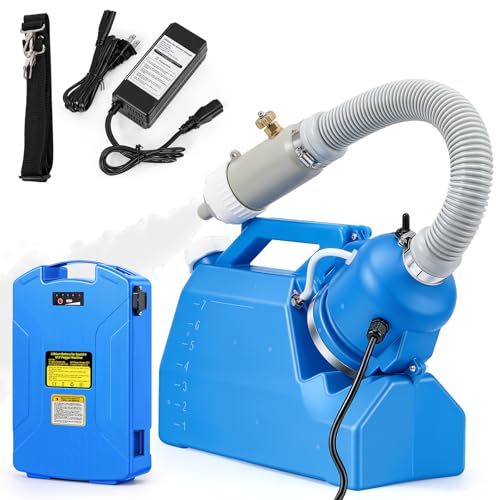
Best for: a homeowner treating plants across a large yard without dragging a cord Skip it if: you only need to mist a shelf or two of seedlings
Spolehli lists a 7L (1.85 gallon) tank, a 12Ah battery, and a runtime claim of 60 minutes on 300W high mode or 100 minutes on 250W low mode. The particle size is adjustable from 10 to 100 microns, and flow rate goes up to 620mL/min in the higher power mode. All of those are the manufacturer's figures, and the fine-mist range in particular is the kind of number worth testing yourself before assuming coverage on a specific pesticide or foliar feed.
It is the most expensive pick here and the slowest seller of the six, and only one seller lists it, so availability is thinner than the other picks. What justifies the price position within this set is the tank size paired with the runtime claim: nothing else here lets a homeowner walk a full yard, treat inside the greenhouse and around fruit trees, and finish before recharging. The trade-off against a corded ULV fogger is that when the battery dies, you wait. Against a hand pump sprayer, the trade-off is bulk and cost for a job you might only do monthly.
Pros:
- 7L tank claim, largest in this set
- 24V lithium pack, no extension cord
- Adjustable 10-100 micron particle claim
- Dual 250W/300W power modes
- 60-100 min runtime claim per charge
Cons:
- The most expensive pick here
- Only one seller lists it
- 12Ah battery adds carry weight over a hand pump
3. INTER HUT 6x6 Pop Up Greenhouse — Best for heavy use
Two power access ports built into the cover is the single feature that separates this from every other shell a homeowner will scroll past.

Best for: a gardener who wants a full 6x6 walk-in with power ports built in Skip it if: you have less than seven feet of vertical clearance
The dimensions are 87.4 x 70.9 x 70.9 in, so a nominal 6x6 footprint and just over seven feet of height at the ridge. INTER HUT describes a pop-up design with a centre lock system for one-person assembly without tools, a reinforced steel frame with a gable roof, a PE cover with UV protection, dual roll-up zippered doors, and two power access ports for heaters or grow lights. The listing also states a 1-year limited warranty from the original date of purchase, which is the only published warranty on any shell in this set.
That warranty and the two power ports are why this earns the heavy-use label. If you plan to run a battery heater through winter starts or plug a grow light on a timer, the ports save you cutting the fabric. It is priced in the upper tier of this set and it is the second-slowest seller, but the sales rank matters less on shells than it does on consumables. The trade-off against the Gentingbro is footprint: 6x6 needs a level square patch that a lean-to does not.
Pros:
- 2 power access ports for heaters or lights
- Gable roof for water shedding and headroom
- 1-year limited warranty stated by INTER HUT
- Dual roll-up zippered doors for cross-ventilation
- Pop-up centre lock claim for tool-free assembly
Cons:
- Needs a level 6x6 patch
- PE cover lifespan not stated
- Priced in the upper tier of this set
4. Generic Indoor Thermograph — Best for families
A dial thermograph with no battery is the monitor you leave inside a greenhouse for a decade and never replace a coin cell in.

Best for: a household that wants a rugged dial gauge kids can read at a glance Skip it if: you need logging or remote alerts on a phone
The listing calls this a mechanical thermograph with a twin pointer display showing temperature and humidity together on double-scale metric and imperial. It uses no battery. That is the whole pitch, and for a homeowner running a battery-powered greenhouse setup it is genuinely useful: one less thing pulling a coin cell inside a humid box. Mounting works two ways, a back suspending hole for a wall and a base for a shelf.
It is the second-cheapest pick here. Only one seller lists it and there is no stated warranty. Neither of those is unusual for a Generic-brand analog instrument, but they are worth naming. The trade-off against a digital hygrometer is real. You get no min/max memory, no dew point calculation, and no alarm. For a family greenhouse where the point is glance-and-move-on, that trade-off is fine. If you want data, this is not the pick. For a monitor you can hang next to seedlings and read from the door, it is the right shape.
Pros:
- No battery, no coin cell to replace
- Twin pointer for temperature and humidity
- Metric and imperial on the same face
- Back hole and base for wall or shelf
- Second-cheapest of the six
Cons:
- No min/max memory
- No dew point calculation
- No stated warranty
5. JAMIEKA Solar Double Fan Set — Best compact
Two 3000 RPM fans running off a 16W monocrystalline panel is the airflow answer for a homeowner who does not want to run power out to the greenhouse.

Best for: a small greenhouse or coop that overheats on sunny afternoons Skip it if: you need airflow at night or on overcast days
Dimensions on the listing are 1.18 x 17.7 x 8.66 in, and JAMIEKA states a 16W monocrystalline silicon panel driving two fans rated up to 3000 RPM, with an IP65 rating and epoxy resin laminated surfaces. There is also a 90-day manufacturer warranty, which is the only published warranty on the hardware in this set outside the INTER HUT shell.
Here is the trick with a solar exhaust fan. It runs when the sun runs, which is exactly when the greenhouse is hottest and airflow matters most. That is a feature, not a bug, for a summer overheating problem. It is also why it is not a night ventilation solution. If your issue is dawn humidity rather than midday temperature, this pick misses the target. It sits mid-range on price within the six. The trade-off against a mains-powered inline fan is straightforward: no wiring, no controller, no thermostat, but no operation when the panel is shaded.
Pros:
- 16W monocrystalline panel claim
- 3000 RPM twin-fan claim
- IP65 rating stated by JAMIEKA
- No wiring or extension cord needed
- 90-day manufacturer warranty stated
Cons:
- Runs only when the panel gets sun
- No thermostat or controller included
- 90-day warranty is short compared with mains fans
6. Generic Analog Thermograph — Best budget pick
The cheapest of the six, and the honest answer for a second monitor at the far end of a greenhouse.

Best for: a second monitor for the far corner of the greenhouse Skip it if: you want a single digital hub for temperature, humidity and dew point
Same mechanical sensing story as the pick above, in a different case. Twin pointer display, double-scale for metric and imperial, back suspending hole for wall mounting, base for desk or shelf, no battery required. The listing does not publish dimensions beyond "refer to description", which is one reason it stays budget rather than family-first. Only one seller lists it, no warranty is stated.
I would use this as a companion to the pick above, not a replacement. A 6x6 walk-in has a temperature gradient from the sunny end to the shaded end that a single gauge misses. Two of these, one at each end, tells you whether you need to open the second zippered door. It is the cheapest of the six by price rank, and it is a small enough purchase that the trade-off against a wireless twin-sensor digital kit is really about whether you value simplicity over data. For a homeowner already juggling a battery sprayer and a solar fan, the answer is often simplicity.
Pros:
- The cheapest of the six
- No battery to replace
- Double-scale metric and imperial
- Wall or shelf mounting options
- Pairs with the pick above for two-zone reading
Cons:
- Dimensions not published
- No stated warranty
- No data logging of any kind
How the six picks fit together in a real backyard
A homeowner running the best battery powered greenhouse for homeowners does not buy one item. They buy a shell, a way to move air, a way to spray, and a way to see what is happening inside. Here is how the six fit together in practice:
- Shell against a fence or wall: Gentingbro at 79 x 31 x 59 in.
- Shell as a freestanding walk-in with power ports: INTER HUT at 87.4 x 70.9 x 70.9 in.
- Cordless spraying across the yard: Spolehli with its 7L tank and 24V pack.
- Daytime ventilation with no wiring: JAMIEKA solar double fan set.
- Battery-free monitoring at the door: the two Generic thermographs, one per end.
You do not need all six. A cold-frame homeowner running the Gentingbro against a fence can skip the INTER HUT. A homeowner in a shaded yard with no solar exposure should skip the JAMIEKA and wire a small inline fan through the INTER HUT's power ports instead. The point is to match the picks to how the yard actually behaves, not to buy the whole shortlist.
What the listings do not tell you about setup
Three things the product listings gloss over that a homeowner learns the hard way:
- Anchor into the ground, not into the frame. The Gentingbro ships with four stakes for a reason. A PE-covered shell acts like a sail, and a strong gust will drag it across a lawn even fully assembled. Stakes into soil, ropes to something heavier than the frame itself.
- Cut the cord port before you need it. If you buy the Gentingbro rather than the INTER HUT, decide where a cord will enter before you put the cover on. A single small slit at a seam, sealed with clear tape, beats a jagged cut made in a hurry when the frost forecast lands.
- Solar panels want the same sun your plants want. The JAMIEKA panel needs direct light to hit 3000 RPM. If you tuck it under the greenhouse's own shade, it underperforms. Mount the panel on the sunny side of the roof or on a separate south-facing post.
None of that is in the bullets. All of it decides whether a battery-and-solar greenhouse setup lasts a season or a decade.
Which pick suits which homeowner?
A quick decision tree, in the order most homeowners actually reach the fork:
- Do you have a fence or house wall to lean against? Yes: Gentingbro. No: INTER HUT.
- Will you run a heater or grow light? Yes: INTER HUT, for the power access ports.
- Do you have direct sun for at least six hours? Yes: JAMIEKA solar fan pairs with either shell. No: skip solar, wire an inline fan.
- Do you spray plants beyond a few shelves? Yes: Spolehli, for the 7L tank and cordless pack. No: a hand sprayer is enough.
- Do you want data or a glance? Data: buy a digital hub separately. Glance: one or two of the Generic thermographs.
Answer those five and the shortlist collapses to the two or three items you actually need.
The verdict
For most homeowners in this set, the best battery powered greenhouse for homeowners is the Gentingbro lean-to at 79 x 31 x 59 in. The reasons are the ones the listing publishes: a fence-side footprint that fits between a bed and a wall, a PE cover the manufacturer states as sun-proof and waterproof, and four wind ropes plus four ground stakes as a real hardware count. It is mid-priced within this set and shaped for the yards most homeowners actually own, where a 6x6 square of level ground is harder to find than a strip along a fence.
The runner-up is the INTER HUT 6x6 walk-in at 87.4 x 70.9 x 70.9 in, and its exact advantage is two power access ports in the cover plus a 1-year limited warranty stated by INTER HUT. If your plan is a battery heater, a grow light on a timer, or an inline fan run off a battery pack, the INTER HUT is the better buy because the ports save you cutting the fabric and the warranty gives you a call to make when something fails. The cutoff between them is whether you have a fence to lean against. If yes, Gentingbro. If no, INTER HUT.
FAQ
Is a battery powered greenhouse actually a real category?
Is a battery powered greenhouse a real category? Not quite as a single product. A greenhouse shell is passive: steel poles and a PE cover. What is real is a battery-powered greenhouse setup, where the shell pairs with a solar fan, a battery sprayer, and battery-free monitors. Amazon's search returns a mixed set because that is how the ecosystem actually ships.
Is the Gentingbro lean-to worth it over a freestanding walk-in?
Is the Gentingbro worth it depends on your yard. If you have a fence or house wall, the 79 x 31 x 59 in lean-to footprint uses space a walk-in cannot, and the sloped roof sheds water away from the wall. If you have a level 6x6 patch and want power access ports built in, the INTER HUT walk-in is the better buy at a higher price position.
What size fits under a covered patio or low overhang?
What size fits under a low overhang is a clearance question. The Gentingbro stands 59 in tall at the high side, so it fits under most patio covers with room to spare. The INTER HUT is 87.4 in tall, just over seven feet, which is too tall for most residential patio ceilings. Measure the low point of your overhang before ordering either shell.
Gentingbro versus INTER HUT: which is better for winter starts?
Gentingbro versus INTER HUT for winter starts hinges on power. The INTER HUT lists two power access ports in the cover, which means a battery or plug-in heater cord runs through the fabric cleanly. The Gentingbro does not publish ports, so you cut and seal a seam yourself. For a homeowner planning any winter heating, the INTER HUT is the safer choice despite its higher price position.
What do people overpay for on a battery powered greenhouse for homeowners?
What people overpay for on a battery powered greenhouse for homeowners is usually a big rigid-panel structure they only use three months a year. A PE-covered pop-up or lean-to like the two shells here handles most residential seasons for a fraction of the outlay. The money is better spent on the cordless sprayer, the solar fan, and two thermographs that make the shell actually work.
Start with the shell. Measure the strip along your fence or the square in the middle of the lawn, decide which shape the yard supports, and buy the Gentingbro or the INTER HUT accordingly. Add the JAMIEKA solar fan only if the roof line catches direct afternoon sun, and add the Spolehli sprayer only if your garden extends beyond the greenhouse itself. The two Generic thermographs cost little enough that buying both, one at each end of the shell, is the right default. The reason the Gentingbro wins for most homeowners is not that it is the biggest or the cheapest. It is the shape that fits the yards homeowners actually have, against the walls they already own.