Best Electric Polycarbonate Greenhouse for Backyards

Seven polycarbonate greenhouses compared by panel type, frame strength and footprint. The AMERLIFE 12x10 wins on space and wind rating; a smaller pick suits tight patios.

By Eli DixonUpdated 16 min read
On this page
- Can you actually make one electric?
- Best electric polycarbonate greenhouse at a glance
- How I ranked seven greenhouses
- Twin-wall or hybrid panels: which holds heat?
- 1. AMERLIFE 12 x 10 x 8-Ft Hybrid Polycarbonate Greenhouse — Best overall
- 2. IDEALHOUSE 6x10 FT Greenhouse — Best for heavy use
- 3. Kingdura 6x12ft Walk-in Greenhouse for Outdoors — Most versatile
- 4. Superlele 6x4FT Greenhouse Heavy Duty Polycarbonate — Best for families
- 5. Wanan Greenhouses for Outdoors — Best budget pick
- 6. Sinimaka 10 Pack Polycarbonate Greenhouse Panels — Best upgrade
- 7. Yardenaler 8x16 FT Greenhouse for Outdoor — Best premium
- How much floor space do you really need?
- What the listings leave out
- The verdict
- FAQ
The best electric polycarbonate greenhouse for most backyards is the AMERLIFE 12 x 10 x 8-Ft Hybrid Polycarbonate Greenhouse, a 245 lb structure rated to 56 mph winds with 435 cu. ft. of usable space. If your yard runs long and narrow instead of wide, the Kingdura 6x12ft Walk-in Greenhouse fits the same growing ambition into a slimmer 70.9-inch width. One caveat up front: none of these ship with wiring, so "electric" is something you add.
Can you actually make one electric?
Here's the honest answer before you spend a cent. None of these seven listings include a heater, a fan, lighting or any wiring. The word "electric" describes what you do after assembly, not what arrives in the box. So a best electric polycarbonate greenhouse is really a well-sealed shell you power yourself.
What decides whether that works is the panel and the seal. Polycarbonate holds heat far better than single-pane glass, which matters the moment you plug in a heater. The tighter the frame, the less warm air leaks out and the less your electric bill climbs.
Three things you'll add:
- A thermostatic heater sized to the enclosed volume
- An exhaust or circulation fan, since sealed heat needs moving air
- Grow lights or a timer strip if you start seedlings early
None of that is exotic. But run the extension cord safely, use an outdoor-rated GFCI outlet, and never assume a panel is watertight around a cable pass-through. That's the part the listings won't tell you.
Best electric polycarbonate greenhouse at a glance
| Pick | Footprint | Panel type | Price |
|---|---|---|---|
| 12 x 10 x 8 ft | Hybrid clear + translucent | Check Price | |
Best for heavy use IDEALHOUSE 6x10 FT Greenhouse |
6 x 10 ft, 72 in tall | Solid PC panels | Check Price |
Most versatile Kingdura 6x12ft Walk-in Greenhouse |
6 x 12 ft | 4.6mm twin-wall (claim) | Check Price |
Best for families Superlele 6x4FT Greenhouse |
6 x 4 ft, ~6.2 ft tall | Twin-wall hollow (claim) | Check Price |
Best budget pick Wanan Greenhouses for Outdoors |
6 x 4 ft | 4mm double-wall (claim) | Check Price |
Best upgrade Sinimaka 10 Pack Polycarbonate Panels |
8 x 4 ft panels, x10 | 0.24 in twin-wall | Check Price |
Best premium Yardenaler 8x16 FT Greenhouse |
8 x 16 ft | 6mm multi-layer | Check Price |


How I ranked seven greenhouses
I worked from the published listing data, not a test bench. Here are the three reasons picks moved down before I decided what led.
- No published weight or wind rating. A frame's heft is the clearest proxy for how well it stands up to wind and snow, and only three listings publish a weight. The Kingdura and Superlele don't, so they can't lead on durability no matter how strong the marketing reads.
- Panels only, not a greenhouse. The Sinimaka set is ten replacement sheets, not a structure. That knocked it out of any "buy this and grow" ranking, though it earned a place as an upgrade path.
- Footprint mismatch. A 6x4 ft box and a 12x10 ft room aren't competing for the same buyer, so I judged each against its likely yard rather than against each other.
What survived came down to two things I could actually compare across the set: footprint and published frame data. The best electric polycarbonate greenhouse should give you room to work and a body heavy enough to trust. The AMERLIFE does both. Everything else trades one for the other, and I've named the trade in each section below.
Twin-wall or hybrid panels: which holds heat?
This is the specification that misleads people. Buyers fixate on panel thickness, but panel type matters more once you plan to heat the space electrically.
- Twin-wall (hollow) panels trap a layer of air between two sheets. The Superlele, Kingdura, Wanan and Sinimaka all use this design. Kingdura claims 4.6mm and over 92% light transmission; Wanan claims 4mm double-wall. That trapped air is what slows heat loss.
- Hybrid panels, as on the AMERLIFE, mix clear and translucent sheets. AMERLIFE says this balances impact resistance, UV protection and light. Clear over the work area, diffuse over the plants.
- Multi-layer is Yardenaler's term for its 6mm panels, described as high light transmission with UV protection.
For an electric setup, twin-wall or thicker multi-wall is the friendlier choice, because the insulating gap keeps your heater from fighting the cold glass. Sinimaka's replacement sheets are the thickest here at 0.24 inches, roughly 6mm, and the maker claims they hold from -40°C to 120°C. If insulation is your priority, look at wall construction first and thickness second. A 4mm twin-wall panel often outperforms a thicker single sheet.
1. AMERLIFE 12 x 10 x 8-Ft Hybrid Polycarbonate Greenhouse — Best overall
The AMERLIFE wins on sheer usable room and the only substantial wind and snow rating published in this set.
Best for: gardeners who want maximum floor space and a high wind rating Skip it if: your yard is smaller than 12 feet in one direction
What sets this pick apart is scale backed by numbers. It lists 435 cu. ft. of usable space inside a 12 x 10 x 8-ft body, and at 245 lb it's the second-heaviest structure here. That mass is why AMERLIFE can quote real figures: winds up to 56 mph and snow loads up to 18 psf. No other complete greenhouse in this group publishes both. When you plan to run a heater through winter, a frame that shrugs off snow is exactly what you want overhead.
The maker says the quick-connect system cuts install time by about 50% and that three people can build it in around six hours. Two adjustable roof vents and an integrated gutter handle airflow and rainwater. The hybrid panels mix clear and translucent for light and impact resistance. It also ships with spear-shaped bird spikes, an odd but welcome touch.
The trade-off is footprint and price. This is the most expensive complete greenhouse here and needs a genuinely large flat area. Small yards need not apply.
Pros:
- 435 cu. ft. of usable space, the largest here
- Rated to 56 mph winds and 18 psf snow
- 245 lb frame signals a heavy, stable body
- Two adjustable roof vents plus a gutter system
- Hybrid clear and translucent panel mix
Cons:
- The highest price of any complete greenhouse in this set
- Needs a large flat footprint most small yards lack
- Six-hour build best done with three people
- No heater, fan or wiring included
2. IDEALHOUSE 6x10 FT Greenhouse — Best for heavy use
The IDEALHOUSE pairs a tall 72-inch walk-in body with a published 86.2 lb weight, so daily tending feels comfortable.

Best for: growers who tend plants daily and want a taller walk-in body Skip it if: you need a wide footprint rather than a long narrow one
This is the pick for someone in and out of the greenhouse constantly. It measures 75.6 x 120 x 72 in, giving full standing headroom down a 10-foot run, and it's the one buyers in this group choose most often. At 86.2 lb it publishes a real weight, unusual at this size, which helps you trust the frame in wind. IDEALHOUSE points to heavy-duty ground spikes and a reinforced aluminum frame, plus base feet that anchor in multiple ways for wind and snow.
Access is the strong suit here. A sliding lockable door and a roof vent make daily airflow control simple, and rain gutters on both sides guide water off the frame. The slide-in panel system, the maker says, keeps assembly straightforward. That matters when you're the one building it.
The trade-off against the AMERLIFE is width. Six feet across is narrow, so you'll work a long aisle rather than a room. And like the rest, it arrives without any electric gear, so budget for a heater and fan separately.
Pros:
- Full 72-inch standing height for daily use
- Published 86.2 lb weight at this footprint
- Sliding lockable door for easy access
- Rain gutters on both sides
- Multiple base anchoring options claimed
Cons:
- Only 6 feet wide, so a narrow aisle
- No wind or snow rating published
- No heating or ventilation power included
- Long shape needs a straight run of yard
3. Kingdura 6x12ft Walk-in Greenhouse for Outdoors — Most versatile
The Kingdura stretches to a full 12-foot length at an entry price, making it the most adaptable footprint here.

Best for: backyard gardeners wanting length without a premium price Skip it if: you want published weight and wind figures before buying
Length is where this one earns its place. At 80.3 x 140.2 x 70.9 in, the Kingdura matches the AMERLIFE's 10-foot depth and then some, while sitting in the entry price tier. That's a lot of growing run for the money. Kingdura claims reinforced 4.6mm twin-wall polycarbonate with over 92% light transmission, UV-coated panels and better heat retention than thinner sheets. For an electric grow space, that twin-wall gap is genuinely useful insulation.
The maker describes adjustable skylights and a sliding door for temperature and humidity control, and says the slide-in panel system speeds setup by up to 40% after more than 500 tests. Take the percentages as marketing, but the 12-foot footprint is a hard fact.
The weakness is transparency of data. Kingdura publishes no weight and no wind or snow rating, so you're trusting the frame claims rather than a number. Against the heavier AMERLIFE, that's the gap. Its narrow 70.9-inch width also means a single working aisle rather than a room you move around in.
Pros:
- Full 140-inch length in the entry price tier
- Claimed 4.6mm twin-wall panels for insulation
- Over 92% light transmission (maker claim)
- Sliding door plus adjustable skylight vents
- Matches premium picks on growing length
Cons:
- No published weight, wind or snow rating
- Narrow 70.9-inch width, single aisle
- Light-transmission figure is unverified
- No electric heating or fan included
4. Superlele 6x4FT Greenhouse Heavy Duty Polycarbonate — Best for families
The Superlele squeezes a ~6.2-ft walk-in height into a compact 6x4 body, so small yards still get real headroom.

Best for: first-time growers with a small yard and kids underfoot Skip it if: you plan to grow tall climbing crops
For a household short on space, this is the sensible starter. It measures 74.8 x 69.7 x 46.4 in and, per the listing, stands about 190cm, roughly 6.2 ft, so most adults can walk in and tend plants without stooping. The white powder-coated aluminum frame is the only non-black complete structure here, which some gardeners prefer near a house. Superlele describes it as rust-resistant, with high-impact twin-wall hollow panels for thermal insulation and UV protection.
Family-friendly details help: a hinged lockable door secures tools and keeps curious hands out, and an adjustable roof vent handles temperature. The twin-wall panels, if the claim holds, keep an electric heater efficient in a small volume, which is exactly where a compact box shines.
The honest limits are size and missing data. A 6x4 footprint fills quickly once you add benches, and Superlele publishes no weight and no wind rating, the same blind spot as the Kingdura. Tall climbing crops will run out of vertical room fast. As a first greenhouse, though, it's an easy step in.
Pros:
- Roughly 6.2 ft walk-in height in a tiny footprint
- Lockable hinged door for safety
- Rust-resistant powder-coated aluminum frame
- Twin-wall hollow panels claimed for insulation
- White frame option, unique in this set
Cons:
- Small 6x4 floor fills up fast
- No published weight or wind rating
- Limited vertical room for climbing plants
- No electric components supplied
5. Wanan Greenhouses for Outdoors — Best budget pick
The Wanan is the cheapest pick here, and its 4mm double-wall panels still bring real insulation to a starter build.

Best for: anyone starting out who wants the lowest price here Skip it if: you want thicker twin-wall panels than 4mm
Price is the whole story, and it's a good one. The Wanan is the cheapest of the seven, and it doesn't skimp on the feature that matters most for an electric setup. It uses 4mm, 580g double-wall polycarbonate that the maker says balances light transmission and insulation. That double-wall gap is the same principle the pricier picks rely on, just in a thinner sheet.
Wanan claims a quick-install system that boosts setup speed by up to 40% and frame stability by 35%, plus a reinforced aluminum alloy frame with rust-resistant connectors and strengthened corners. An adjustable roof vent and lockable door round out the essentials. For a first heated greenhouse where you're testing whether the hobby sticks, this covers the basics without a big outlay.
The trade-offs are the thinnest panels in the group and, again, no published weight or wind rating. Against the twin-wall Kingdura or Superlele, 4mm gives up some insulating margin. But as the lowest-cost entry into the best electric polycarbonate greenhouse question, it earns its spot.
Pros:
- The lowest price in this set
- 4mm double-wall panels for insulation
- Reinforced aluminum alloy frame claimed
- Adjustable roof vent and lockable door
- Quick-install system per the listing
Cons:
- Thinnest panels here at 4mm
- No published weight or wind rating
- Setup-speed percentages are marketing claims
- No heater, fan or lighting included
6. Sinimaka 10 Pack Polycarbonate Greenhouse Panels — Best upgrade
The Sinimaka set is ten 0.24-inch twin-wall sheets, the upgrade path for owners fixing or improving an existing frame.

Best for: owners repairing or upgrading panels on an existing frame Skip it if: you need a complete greenhouse, not replacement sheets
This isn't a greenhouse, and that's the point. It's ten 8' x 4' x 0.24'' twin-wall sheets, meant to reglaze a frame you already own or upgrade thin panels to something warmer. At roughly 6mm, these are the thickest polycarbonate in this whole guide, which is why they matter for anyone serious about an electric grow space. Sinimaka says the twin-wall design resists hail and holds from -40°C to 120°C, with a UV-resistant coating blocking 99.9% of UV while passing 89% light.
The listing calls the sheets lightweight and easy to cut without cracking, so fitting them to an odd frame is manageable. Beyond greenhouses, the maker lists uses from cold frames to chicken coop roofs.
The obvious limitation is that you need a structure to attach these to. There's no frame, no door, no vent. If your existing panels have yellowed or cracked, or you want to boost insulation before winter heating, this is the smart move. If you're starting from nothing, buy one of the complete picks instead and keep this in mind for later.
Pros:
- Thickest panels here at 0.24 in twin-wall
- Rated -40°C to 120°C by the maker
- Blocks 99.9% UV, passes 89% light (claim)
- Cuts cleanly without cracking per listing
- Ten sheets cover a large reglazing job
Cons:
- Panels only, no frame or hardware
- Useless without an existing structure
- Priced in the premium tier for parts
- Temperature and light figures unverified
7. Yardenaler 8x16 FT Greenhouse for Outdoor — Best premium
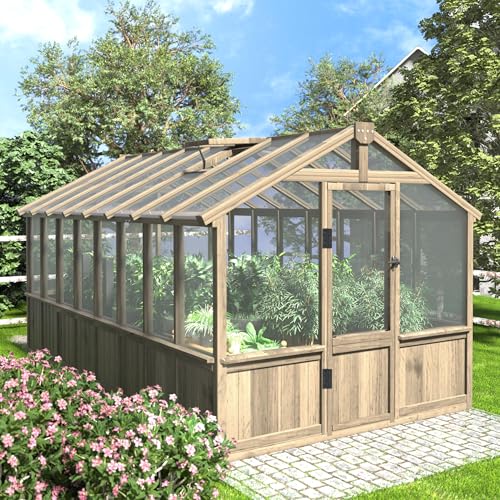
The Yardenaler is the largest structure here, a 427 lb, 8x16 ft wood-look walk-in for serious growing.
Best for: gardeners wanting a wood-look 8x16 structure and long footprint Skip it if: you want the lightest frame to move or reposition
This is the biggest greenhouse in the guide by a clear margin. It measures 96"W x 190.2"D x 90.6"H, giving a 16-foot growing run in a light mocha brown finish that reads more like garden furniture than a plastic box. At 427 lb it's the heaviest structure here, so it plants itself firmly once built. Yardenaler uses 6mm multi-layer polycarbonate for light transmission and UV protection, and the adjustable roof pivots on a joint to set the opening angle. The door measures 29.1"W x 71.4"H, and vents run 21 inches square.
For an electric setup this is a proper room. Heat it, light it, and you have space for benches down both sides plus a work zone. The premium price buys that footprint and the wood-look styling.
The trade-offs are weight and installation footprint. At 427 lb this is not something you reposition on a whim, and Yardenaler advises checking that installation is allowed in your area before buying, a hint at its scale. The maker also publishes no wind or snow rating despite the heft.
Pros:
- Largest footprint here at 8x16 ft
- Heaviest frame at 427 lb, very stable
- 6mm multi-layer panels for insulation
- Wood-look mocha finish, not black
- Adjustable-angle roof vents
Cons:
- The most expensive pick in the set
- 427 lb makes it effectively permanent
- No published wind or snow rating
- May need local approval before install
How much floor space do you really need?
Footprint is where buyers most often overspend or underbuy. Here's the quick map for this set, from smallest to largest.
- 6x4 ft (Superlele, Wanan): a single bench and a standing spot. Right for herbs, seedlings and a first season.
- 6x10 to 6x12 ft (IDEALHOUSE, Kingdura): a long working aisle with plants down one side. Good for a committed hobbyist.
- 12x10 ft (AMERLIFE): a room you move around in, at 435 cu. ft. Benches on multiple walls.
- 8x16 ft (Yardenaler): a small building. Two aisles and a work zone.
For an electric greenhouse, remember that heating cost scales with enclosed volume. A bigger box costs more to keep warm. So don't buy the 8x16 if a 6x10 grows what you want. Measure your flat, level ground first, then match the footprint to it. The narrow picks need a straight run; the wide picks need genuine open space.
What the listings leave out
A few gaps worth knowing before you commit, because these apply across the set.
- No wind or snow rating on most. Only the AMERLIFE publishes both, at 56 mph and 18 psf. The rest rely on frame descriptions, so factor in your local weather.
- No weight on several picks. The Kingdura, Superlele and Wanan skip it. Weight is the best clue to frame substance, and its absence is a real unknown.
- No foundation included. Every one of these needs anchoring to level ground or a base you provide. Ground spikes help but don't replace a firm footing.
- No electric parts, ever. Say it once more: heater, fan, lights and wiring are all yours to add and to power safely through a GFCI outlet.
Read the maker claims as claims. A percentage like "40% faster setup" isn't a measured fact you can hold them to. Judge each pick on the numbers that don't move: size, weight where given, and panel construction.
The verdict
Two tracks, and the split is your yard. If you have genuine open ground and want the safest all-round buy, the AMERLIFE 12 x 10 x 8-Ft Hybrid Polycarbonate Greenhouse is the pick. It's the only complete greenhouse here with both a wind rating (56 mph) and a snow rating (18 psf), it weighs a reassuring 245 lb, and it gives you 435 cu. ft. to work in. When you plan to heat electrically through winter, that published durability is worth paying for.
If your yard runs long and narrow, or the AMERLIFE's price stops you, the Kingdura 6x12ft Walk-in Greenhouse is the smart alternative. Its exact advantage is length for money: a full 140-inch run in the entry price tier, with claimed 4.6mm twin-wall panels that insulate a heated space well. You give up published weight and wind figures, which is the real reason it doesn't win.
The cutoff is footprint width. Below about 7 feet of clear width, take the Kingdura's aisle. Above it, the AMERLIFE gives you a room. And if you already own a frame, the Sinimaka panels upgrade your insulation without a full rebuild.
FAQ
Is an electric polycarbonate greenhouse worth it over glass?
An electric polycarbonate greenhouse is worth it for most home gardeners because polycarbonate insulates better than single-pane glass and resists impact from hail. That matters most once you add a heater, since twin-wall panels like the Kingdura's claimed 4.6mm slow heat loss and cut running costs. Glass wins on clarity and lifespan, but costs more and shatters.
How much floor space do I really need?
How much floor space you need depends on what you grow. For herbs and seedlings, a 6x4 ft box like the Wanan or Superlele is plenty. For a committed hobby, the 6x10 IDEALHOUSE or 6x12 Kingdura gives a full working aisle. Only serious growers need the 12x10 AMERLIFE or 8x16 Yardenaler, and both cost more to heat.
Does the AMERLIFE come with a heater or wiring?
The AMERLIFE does not come with a heater, fan, lighting or wiring, and neither does any pick in this guide. "Electric" describes the setup you add yourself. You'll want a thermostatic heater sized to the 435 cu. ft. interior, a circulation fan, and an outdoor-rated GFCI outlet feeding the greenhouse. Budget for those separately when comparing prices.
AMERLIFE or Kingdura for a small backyard?
AMERLIFE or Kingdura comes down to your yard's shape. The AMERLIFE needs a wide, open 12x10 area and gives you a room to move in, backed by a 245 lb frame and a 56 mph wind rating. The Kingdura fits a narrow 70.9-inch width along a fence or path, runs a full 12 feet long, and costs less. Narrow lots favor the Kingdura.
What mistake do first-time greenhouse buyers make?
The mistake first-time greenhouse buyers make is skipping the foundation and the wind rating. None of these include a base, and only the AMERLIFE publishes wind and snow figures. Buyers also overbuy on size, forgetting that a bigger enclosed volume costs more to heat electrically. Measure your level ground, check local weather, then match the footprint to what you actually grow.
Start by measuring the flat, level ground you have, because that single number decides more than any panel spec. For most backyards with real open space, the AMERLIFE 12 x 10 x 8-Ft Hybrid Polycarbonate Greenhouse is the confident default: it's the only complete pick here that tells you how much wind and snow it will take, and 435 cu. ft. gives you room to grow into rather than out of. Add a GFCI outlet, a thermostatic heater and a fan, and you've turned a well-sealed shell into a proper heated growing space.