Best Greenhouse to Grow Vegetables for Small Spaces

Seven vegetable-growing setups compared on footprint, tier count, light, and cover material. A named winner, a runner-up, and the conditions that flip the pick.

By Eli DixonUpdated 18 min read
On this page
- Best greenhouse to grow vegetables at a glance
- How I screened this shortlist
- 1. Pure Garden 4 Tier Mini Greenhouse — Best overall
- 2. Grezone Walk-in Greenhouse — Best upgrade
- 3. Barrina LP600 Indoor Greenhouse with Grow Light — Best premium
- 4. JESLED Indoor Greenhouse with Grow Light — Most versatile
- 5. VIVOSUN S425 2x4 Grow Tent — Best minimal setup
- 6. Week-by-Week Vegetable Gardener's Handbook — Best for families
- 7. Paradi star Plant Trellis Netting — Best budget pick
- What actually decides a vegetable greenhouse
- Walk-in or tiered: which suits your space?
- How much light do vegetables really need indoors?
- What the listings do not tell you
- Accessories that earn their place
- The verdict
- FAQ
The best greenhouse to grow vegetables in a small home is the Pure Garden 4 Tier Mini Greenhouse, a 63 x 27 x 16 in tower with four shelves rated to 24 lb each and locking wheels for indoor or patio use. If you have a 10 by 7 ft patch outside, the Grezone Walk-in Greenhouse is the better buy: 119 x 79 x 79 in, dual zippered doors, six screen windows, and a 140 g/m² PE cover the brand rates at UV 80+.
Best greenhouse to grow vegetables at a glance
| Pick | Footprint | Light source | Price |
|---|---|---|---|
Best overall Pure Garden 4 Tier Mini Greenhouse |
63 x 27 x 16 in | Ambient only | Check Price |
Best upgrade Grezone Walk-in Greenhouse |
119 x 79 x 79 in | Ambient only | Check Price |
Best premium Barrina LP600 Indoor Greenhouse |
70.9 x 23.6 x 13.8 in | 5-tier 5000K LED, 100W claim | Check Price |
Most versatile JESLED Indoor Greenhouse |
59 x 35.4 x 13.8 in | 6 T8 LED full-spectrum bars | Check Price |
Best minimal setup VIVOSUN S425 Grow Tent |
60 x 48 x 24 in | Bring your own | Check Price |
Best for families Week-by-Week Vegetable Gardener's Handbook |
9.1 x 7.75 x 1 in book | n/a | Check Price |
Best budget pick Paradi star Plant Trellis Netting |
6.5 x 10 ft net | n/a | Check Price |





How I screened this shortlist
The seven picks above are what survived a longer list. I lined up every listing against four filters drawn from the product data itself: a stated footprint, a cover or reflective wall, evidence of shelving or vertical growing space, and a spec sheet detailed enough to compare against the others in the set. Anything that gave only vague dimensions was cut.
That left a real spread of formats:
- Two tiered indoor towers with cover only.
- Two indoor units with included LED lights.
- One walk-in outdoor tunnel.
- One reflective grow tent that expects you to bring lights.
- One book and one trellis net, kept because a vegetable-growing setup is more than the enclosure.
I ranked by which format solves the most common problem for the most readers of the primary keyword. That is a small-space grower with a windowsill, a patio, or a corner of a spare room, and the winner reflects that. If your situation is a real backyard, the ranking flips on the second row.
One caveat on the keyword itself. "Greenhouse to grow vegetables" is a broad phrase, and Amazon's results mix true greenhouses with grow tents, plant stands, and gardening books. I have kept that mix so you can see the format you actually want, but I have not claimed a tent or a book is a greenhouse when it clearly is not.
1. Pure Garden 4 Tier Mini Greenhouse — Best overall
A 63 x 27 x 16 in tower with four 24 lb shelves and locking wheels is the format that fits the most homes, which is why it wins.
Best for: renters and patio growers starting a first vegetable crop Skip it if: you want to walk inside and grow full-size tomato vines
This is the smallest true greenhouse in the set and the third-cheapest of the seven. What makes it the default pick is the ratio of growing area to floor space: four tiers, each 27 in wide with 14 in of vertical clearance, on a footprint under two square feet. That is enough for two flats of seedlings per shelf, or a shelf of herbs and three shelves of leafy greens. Pure Garden lists a tubular steel frame with a clear PVC cover, weight 11.5 lb, and the whole unit rolls on locking wheels you can remove. The green colour is the frame; the cover is clear.
Against the rest of the set, its trade-off is height per shelf. Fourteen inches works for lettuce, spinach, radishes, herbs and seedlings. It does not work for a mature tomato or pepper plant, which is where the walk-in and the taller Barrina overtake it. If your entire crop is salad greens and starts, that limit does not cost you anything.
Pros:
- Small 63 x 27 x 16 in footprint fits a balcony or sunroom
- Four shelves rated to 24 lb each, per the brand
- Locking wheels, removable for a fixed position
- Clear PVC cover lets ambient light through
- Entry-tier price position in this set
Cons:
- 14 in of vertical space per shelf limits crop height
- No lights included, so a north-facing room struggles
- Only one seller lists it, so choice is thin
- PVC cover longevity is not specified
2. Grezone Walk-in Greenhouse — Best upgrade
A 119 x 79 x 79 in tunnel with dual zippered doors and six screen windows is the format that grows adult tomatoes and cucumbers to term.

Best for: backyard gardeners with a 10 by 7 ft patch of level ground Skip it if: you have no outdoor space or the wind exposure is severe
This is the only walk-in in the set, and the specification sheet does more of the talking than usual. Grezone lists a heavy-duty steel frame with cross bars and four reinforced diagonal bars, a powder-coated finish the brand contrasts with plain galvanised frames, and a 140 g/m² PE grid cover the listing rates at UV 80+ and claims is fully waterproof. The mesh door and PE cover door work as a pair: mesh for ventilation on hot days, PE to hold heat overnight. Six screen windows spread the airflow. Total weight is 28 lb, which tells you the frame is real but also that it needs anchoring.
Inside this set, it is the only pick where a six-foot pepper plant is a realistic goal. Against the indoor towers, it costs a bigger commitment: ground preparation, staking, and enough sun. Against the Barrina and JESLED, it gives up the option of growing in a room with no windows. The mid-tier price position looks right for what you get.
Pros:
- Walk-in 119 x 79 x 79 in space fits adult vegetable plants
- Dual doors, one mesh and one PE, per the listing
- Six screen windows spread airflow across the tunnel
- 140 g/m² UV 80+ cover claim, brand rated
- Reinforced steel frame with diagonal bracing
Cons:
- Needs a level 10 by 7 ft outdoor footprint
- 28 lb frame requires anchoring in exposed spots
- No published warranty length
- Assembly time is not specified
3. Barrina LP600 Indoor Greenhouse with Grow Light — Best premium
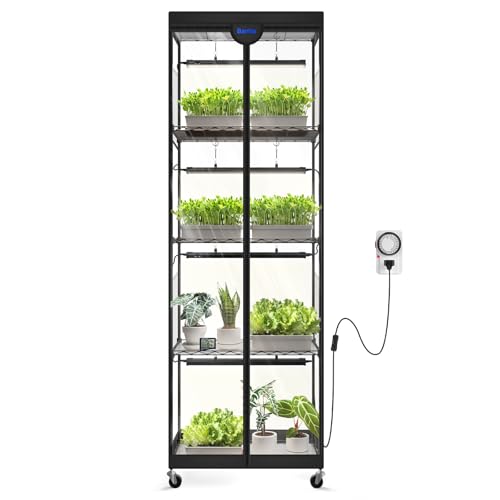
A 70.9 x 23.6 x 13.8 in five-tier stand with 5000K LED bars, a transparent cover and a mechanical timer is the closest thing here to an out-of-the-box indoor vegetable setup.
Best for: apartment growers who want lights, timer and tent in one box Skip it if: you already own a grow light and just need the enclosure
Barrina says the LP600 pairs a 5-tier stand with 1.6 ft 5000K full-spectrum LED bars at CRI 97, a claimed PPFD of 431.9 μmol/m²/s at 3.9 inches, and 100W of total lighting draw. The transparent cover creates the enclosed microclimate; a bottom cover catches soil and water; and a mechanical timer runs the light cycle from 0 to 24 hours. A thermometer is included. That is a lot of parts in one box, and it explains the top price position in this set.
The trade-off is height. At 70.9 in tall across five tiers, each shelf gets roughly a foot of clearance, which is fine for greens, herbs and seedlings but tight for staked tomatoes. Against the JESLED, it wins on the timer, the published PPFD figure and the extra tier. Against the VIVOSUN tent, it wins on being ready to run the day it arrives. If you were going to buy lights, timer and stand separately anyway, one purchase is usually cheaper than three.
Pros:
- 5 tiers with 100W of LED lighting per the brand
- Mechanical timer, 0 to 24 hour cycles
- 5000K full-spectrum bars, CRI 97 claim
- Transparent cover and debris tray included
- DIY shelf-height adjustment
Cons:
- Premium price position in this set
- Roughly 12 in per shelf limits tall crops
- Only two sellers list it
- PPFD figure is at 3.9 in, not canopy distance
4. JESLED Indoor Greenhouse with Grow Light — Most versatile
Five adjustable-height layers, six T8 LED bars and an EVA-material tent make this the flexible mid-format between the small tower and the walk-in.

Best for: seed-starters who want adjustable shelves and included lights Skip it if: you plan to grow anything taller than a determinate tomato
JESLED lists a 59 x 35.4 x 13.8 in enclosure with five adjustable-height layers and six T8 LED grow lights on a tiered control power cord. The tent is EVA material, transparent so you can watch the crop, and the brand says the lights carry an integrated waterproof design suited to greenhouse humidity. Assembly is tool-free with zip ties, per the packaging list. Compared to the Barrina, the standout is the wider 35.4 in footprint, which gives more elbow room per shelf.
What this pick does not publish is a PPFD figure or a wattage total, so on paper the Barrina's light claim is more detailed. That is why it lands here rather than higher. Its case is versatility: the shelf spacing moves, so a shelf of tomato seedlings can become a shelf of half-grown plants without buying a second unit. In a room with limited window light, six LED bars will beat any of the cover-only picks in this set.
Pros:
- 5 shelves with DIY height adjustment
- 6 T8 LED bars, waterproof design claim
- 35.4 in wide shelves, roomier than the Barrina
- Tool-free zip-tie assembly
- Sits in the greenhouse category as a plant-stand kit
Cons:
- No published PPFD or total wattage
- No timer included
- No stated warranty
- Only one seller lists it
5. VIVOSUN S425 2x4 Grow Tent — Best minimal setup
A 60 x 48 x 24 in reflective tent with a two-year warranty is the pick for growers who already own lights and want the enclosure, nothing more.

Best for: growers who own their own lights and want a reflective enclosure Skip it if: you want a transparent cover that lets in real sunlight
The VIVOSUN is the only pick here with a published warranty, which the brand describes as a two-year ironclad guarantee. Construction is 600D Oxford canvas with a reinforced PE lining and 100% reflective mylar walls, per the listing, over metal poles with tool-free corner connectors. There is a viewing window in the plastic and openings for duct fans and cables. Weight is 19.3 lb, and the footprint of 48 x 24 in is closer to a wardrobe than a shelf.
This is the fastest-selling item in the set on the popularity signal supplied, which is worth noting but not the reason to buy. The reason is a simple format decision. A tent traps light, holds humidity, and hides the crop; a cover greenhouse lets sunlight in and shows it off. If your window does not deliver enough sun for tomatoes, the tent plus your own lights beats a clear cover in a dark room every time. Against the Barrina and JESLED, the trade-off is honest: no lights, no timer, no shelving. You supply all three.
Pros:
- Two-year warranty, per the brand
- 100% reflective mylar walls maximise light use
- 600D Oxford canvas with PE lining
- Tool-free corner connectors
- The one buyers choose most often here
Cons:
- No lights, no shelves, no timer included
- Opaque walls block ambient sunlight entirely
- Premium price position for the enclosure alone
- 2 x 4 ft floor is deeper than many closets
6. Week-by-Week Vegetable Gardener's Handbook — Best for families
A 2.31 lb Storey Publishing paperback that turns a vegetable calendar into a weekly list of what to do next.

Best for: first-time vegetable growers who need a weekly plan Skip it if: you already know your frost dates and succession timings
Released in 2011, 9.1 x 7.75 x 1 in, 2.31 lb. That is what the input tells me, and it is enough. A vegetable greenhouse is only as useful as the sowing calendar behind it, and the most common failure mode for a first-year grower is not the enclosure but the timing: seeds started too late, transplants set out too early, a second crop that never gets sown because the first is still in the shelf. A weekly handbook attacks exactly that problem.
Its place in this list is honest: it is not a greenhouse. It is the reason your greenhouse produces food instead of empty shelves. Pair it with the Pure Garden tower or the Grezone walk-in and it earns its keep in the first spring. Against the enclosures, the trade-off is obvious. A book grows nothing on its own. It is here because a family buying their first setup is better served by one enclosure and one plan than by two enclosures and no plan.
Pros:
- Weekly structure suits first-year growers
- Second-cheapest pick in this set
- Compact 9.1 x 7.75 x 1 in reference size
- Two sellers list it, so choice is available
- Storey Publishing, long-established in gardening
Cons:
- Not a greenhouse; grows nothing itself
- Regional advice may need adapting to your zone
- No updates since the 2011 release
- Book weight is 2.31 lb, so not a pocket guide
7. Paradi star Plant Trellis Netting — Best budget pick
A 6.5 x 10 ft polyester mesh with 4 in squares that turns any greenhouse floor into vertical growing space.

Best for: anyone growing tomatoes, cucumbers or beans that need support Skip it if: your crop is lettuce, radishes or bush beans
The cheapest pick here, and the one that changes the yield of whichever enclosure you buy. Paradi star lists a 6.5 x 10 ft polyester net with a 30 x 20 grid of roughly 4 in squares, cuttable to the shape you need, usable vertically or horizontally. The listing says it will carry heavy fruiting crops without breaking. There is no published weight rating and no warranty, so treat those claims with the usual caution.
Its case is simple arithmetic. Every enclosure in this list has floor area you paid for. A vining tomato or a cucumber wants 4 to 6 ft of vertical space it will not use without support. A net at 6.5 x 10 ft covers a full wall of the Grezone walk-in or the back of a VIVOSUN tent, and doubles the productive volume without adding a square foot of floor. Its trade-off against the greenhouses is that it is not one: it produces nothing on its own. In this list it is the accessory that most reliably improves the vegetable output of the pick above it.
Pros:
- Cheapest pick in this set
- 6.5 x 10 ft covers most of a wall
- 4 in squares fit tomato, cucumber and bean stems
- Cuttable polyester, so no wasted material
- Works vertically or horizontally
Cons:
- Not a greenhouse; adds no shelter
- No published weight rating
- No warranty stated
- Slowest seller in this set on the popularity signal supplied
What actually decides a vegetable greenhouse
Most guides to the best greenhouse to grow vegetables lead with cover material or brand. That is not what decides it for a home grower. The real question is a two-part cutoff: where you will put it, and where the light comes from.
Location comes first. If you have a level 10 by 7 ft patch outside, a walk-in like the Grezone gives you crop height no indoor tower matches, and it uses free sunlight. If you have a balcony or a spare room, the walk-in is impossible and you fall to a tower like the Pure Garden or one of the lit indoor units.
Light comes second. A clear cover only helps if daylight reaches it. In a south-facing sunroom, the Pure Garden's PVC cover captures what the room already gets. In a room where the sun never reaches the corner you have for it, a clear cover does nothing and you need LEDs. That is when the Barrina and JESLED earn their price positions, and when the VIVOSUN plus your own lights becomes a real option.
The obvious specification, cover thickness, matters least of the three. It matters for outdoor durability, which is why the Grezone's 140 g/m² UV 80+ claim is worth reading. For indoor use, cover material barely affects yield.
Walk-in or tiered: which suits your space?
Here is the honest split, drawn from the footprints in this set.
- Under two square feet of floor available. The Pure Garden at 27 x 16 in is the only pick that fits. Four shelves of greens and herbs is a real crop.
- A whole corner of a room, indoors. The Barrina at 23.6 x 13.8 in, the JESLED at 35.4 x 13.8 in, or the VIVOSUN at 48 x 24 in. Choose by whether you want lights included, adjustable shelves, or a reflective enclosure for lights you already own.
- A 10 by 7 ft patch outside. The Grezone walk-in is the pick. Nothing else in this list gets close on internal volume.
- No enclosure at all yet, but climbing crops on your list. The Paradi star net adds vertical space to any of the above.
The one combination the data does not solve is a windy, exposed outdoor spot with no room for a full walk-in. If that is your situation, a hoop tunnel outside the scope of this list will serve you better than any pick here.
How much light do vegetables really need indoors?
Vegetables split into three light classes, and picking the wrong pick for your class is the most common expensive mistake.
- Leafy greens and herbs. Lettuce, spinach, kale, basil, parsley, cilantro. These will fruit poorly, but you eat the leaves, so that is fine. A clear-cover tower like the Pure Garden works in a bright room. A lit unit like the JESLED works in a dim one.
- Root and quick crops. Radishes, baby carrots, spring onions. These want more light than greens but less than fruiting crops. A five-tier lit unit like the Barrina, with its 5000K LED bars and 100W claim, is the right tool.
- Fruiting crops. Tomatoes, peppers, cucumbers, aubergines. These want the most light and the most vertical space. Indoors, that means the Barrina or the VIVOSUN plus a stronger dedicated light. Outdoors, that means the Grezone walk-in.
The trap to watch is buying a lit indoor unit for fruiting crops and expecting field yields. Barrina's PPFD figure of 431.9 μmol/m²/s is measured at 3.9 inches from the bar. At canopy distance for a 2 ft tomato plant, it will be lower. The best greenhouse to grow vegetables of a specific type is the one whose light and height match that crop, not the one with the biggest number on the box.
What the listings do not tell you
Four things worth knowing before you commit.
- Cover life. Only the Grezone publishes a UV rating on its cover, at UV 80+, with the brand's own comparison to weaker UV level 3 covers. The Pure Garden's PVC cover has no stated UV figure. Outdoor covers degrade; indoor covers rarely do.
- Warranty. Only the VIVOSUN publishes one, at two years. Every other enclosure in this list is silent on warranty length. That does not mean there is none, but it does mean you have no published figure to hold the brand to.
- Assembly time. JESLED says tool-free and includes zip ties in the packaging list. VIVOSUN says tool-free corner connectors. The rest do not commit to a time or a tool count. Budget an afternoon for the Grezone walk-in in particular.
- Anchoring. The Grezone weighs 28 lb empty. An enclosure with that footprint and that weight moves in wind. Anchoring hardware is not in the listing description; assume you supply it.
Accessories that earn their place
The Paradi star net is on this list on purpose, and it points to a wider truth: an enclosure alone is not a growing system. Three add-ons make the most difference across the picks above.
- Vertical support. A trellis net or a set of stakes turns floor area into wall area. The Paradi star's 4 in squares fit most vining crops.
- A watering routine you can automate. None of the picks include irrigation. A simple wick tray under each shelf saves the setup on the week you forget.
- A thermometer. The Barrina is the only pick with one included. The others assume you own or will buy one. For a walk-in like the Grezone, a min-max thermometer is close to essential.
None of these are exciting purchases. All of them decide whether the enclosure produces food or a graveyard.
The verdict
For the reader who typed the primary keyword into a search bar, the best greenhouse to grow vegetables is the Pure Garden 4 Tier Mini Greenhouse. Four 27 in shelves at 14 in of clearance, a 63 x 27 x 16 in footprint, 11.5 lb, locking wheels, PVC cover: that specification fits more homes than any other pick here, and the entry-tier price position makes it a low-risk first purchase.
The cutoff is space. If you have a level 10 by 7 ft outdoor patch and want to grow adult tomatoes, peppers or cucumbers, the Grezone Walk-in Greenhouse is the better buy, and the deciding advantages are concrete: 119 x 79 x 79 in of internal volume, a 140 g/m² UV 80+ cover claim, six screen windows for airflow, dual mesh and PE doors, and a reinforced steel frame with diagonal bracing.
If your room is dim, the Barrina LP600 solves a different problem with its 5-tier stand, 5000K LED bars, mechanical timer and thermometer. It is the most expensive pick here and the answer when free sunlight is not on the table. Everything else in the list serves a narrower reader: adjustable shelves, an enclosure for lights you already own, a weekly plan, a trellis net.
FAQ
Is a mini greenhouse actually enough to grow vegetables?
A mini greenhouse is enough to grow the vegetables it fits. The Pure Garden's 14 in of vertical clearance per shelf will produce lettuce, spinach, kale, radishes, herbs and seedlings across four 27 in shelves. It will not produce a mature tomato or pepper plant. Match the crop to the height, and a 63 x 27 x 16 in footprint is real growing space.
Is the Barrina LP600 worth the premium over the JESLED?
The Barrina LP600 is worth the premium if the timer and the published light figures matter to you. Barrina lists 5000K CRI 97 bars, a PPFD of 431.9 μmol/m²/s at 3.9 inches, 100W of total lighting, and a mechanical 0 to 24 hour timer. JESLED includes six T8 LED bars but publishes no PPFD or wattage total, and no timer.
Can I grow vegetables in the VIVOSUN grow tent without buying lights?
You cannot grow vegetables in the VIVOSUN grow tent without buying lights. The 100% reflective mylar walls block ambient sunlight by design; the tent's job is to trap the light you supply. Budget for an LED grow light sized to the 48 x 24 in floor before ordering, or pick the Barrina or JESLED instead, both of which include lights.
Pure Garden 4 Tier or Grezone walk-in for a beginner?
Pure Garden 4 Tier or Grezone walk-in comes down to whether you have outdoor space. The Pure Garden's 63 x 27 x 16 in tower fits a patio, sunroom or balcony and needs no ground preparation. The Grezone's 119 x 79 x 79 in tunnel needs a level 10 by 7 ft patch, anchoring, and enough sun. Start indoors if either condition fails.
Do vegetables need a greenhouse cover at all, or just lights?
Vegetables need a greenhouse cover for two reasons lights do not fix: humidity and temperature stability. A clear or reflective cover holds warm, moist air around the crop, which speeds germination and reduces watering. Lights add photons, which matter for growth rate and fruiting, but a bright, dry, cold room still stalls seedlings. The combination beats either alone, which is why the Barrina pairs them.
Start with the space you actually have measured. If it is under two square feet indoors, the Pure Garden 4 Tier tower is a low-risk way to find out whether you enjoy growing food before you spend more. If it is a real patch outside, skip straight to the Grezone walk-in and put the difference in price toward anchoring, a thermometer and a bag of good soil. Everything else in this list is a refinement on those two decisions. Buy the plan alongside the enclosure, add a trellis net once your first tomato reaches the second shelf, and the system does the rest.