Best Wall Trellis for Steep Hills: Slope-Ready Picks

Five wall-mounted trellises judged for slope duty: how the panel meets the wall, what the frame weighs, and which pick suits a retaining wall versus a shed cladding.

By Eli DixonUpdated 16 min read
On this page
- Best wall trellis for steep hills at a glance
- How I screened the shortlist for slope duty
- Why the obvious spec misleads on a hillside
- 1. Dura-Trel Cambridge Wall Mounted Garden Vinyl Trellis — Best overall
- 2. CJGQ 2-Pack Expandable Wooden Lattice Wall — Best budget pick
- 3. ArdeFentium 60 x 33.3 in Metal Garden Trellis — Best minimal setup
- 4. MyGift Wall Mounted Metal Garden Trellis, Set of 2 — Best upgrade
- 5. MyGift Wood Wall Hanging Garden Trellis, Set of 2 — Best premium
- What steep-hill buyers should check before ordering
- How the five picks compare on frame weight
- Which wall surface should you mount it to?
- What owning a wall trellis on a slope actually involves
- The verdict
- FAQ
The best wall trellis for steep hills is the Dura-Trel Cambridge, a 76 x 28 in vinyl grid rated for two decades of outdoor exposure and stiff enough to sit flush against an uneven retaining wall. If you are covering a wider run or two separate wall bays, the CJGQ expandable wooden lattice gives you two panels that stretch to 12.8 x 67 in each, at the lowest price position in this set. Get the anchoring right and either will outlast the plants you train up it.
Best wall trellis for steep hills at a glance
| Pick | Panel size | Frame material | Price |
|---|---|---|---|
Best overall Dura-Trel Cambridge |
76 x 28 in, single panel | PVC with stabilizer, 20-year warranty | Check Price |
Best budget pick CJGQ Expandable Wooden Lattice |
12.8 x 67 in expanded, set of 2 | Carbonized wood, 2.09 lb total | Check Price |
Best minimal setup ArdeFentium Metal Trellis |
60 x 33.3 in, single panel | 8mm tube frame, 4mm mesh (claim) | Check Price |
Best upgrade MyGift Metal Lattice |
50 x 24.1 in, set of 2 | Powder-coated steel, 14.1 lb total | Check Price |
Best premium MyGift Wood Lattice |
70.9 x 19.7 in, set of 2 | Wood lattice, 5.84 lb total | Check Price |


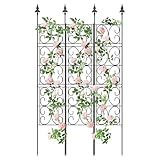


How I screened the shortlist for slope duty
Amazon's search for "wall trellis" pays little attention to the "steep hills" qualifier, so I did that filtering myself. I started with the trellises that ship with clear wall-mount intent, then pulled the specifications side by side to see which would actually behave on a hillside wall.
Three criteria did the cutting, in this weight order:
- Rigidity across the panel. A trellis on a slope-facing wall gets uneven wind loads and, sometimes, uneven wall surfaces. A frame that flexes at the corners transmits every gust into your fasteners.
- Frame weight relative to panel area. Heavy panels need beefier anchors and, on a retaining wall, more thoughtful drilling. Light panels forgive an imperfect stud but wave in a strong breeze.
- Mounting geometry. Panels with defined bracket points beat panels that expect you to improvise. On a hillside you often mount high, on a ladder, one-handed, and the last thing you want is guesswork.
Everything without a published dimension went out. Panels shorter than about two feet in the long axis went out as well, because a slope wall usually needs vertical coverage, not decorative squares. That left the five picks below, spread across vinyl, wood and metal so you can match the trellis to the wall you actually own.
Why the obvious spec misleads on a hillside
Most trellis guides compare height, then declare a winner. On a steep hill, height is not the deciding specification. Anchoring geometry is.
A tall panel on a slope wall is only as strong as the fasteners that hold it, and the wall behind those fasteners. A 76 in vinyl panel bolted through four points into solid masonry outperforms a 70 in wood set hung on drywall anchors, every time. That is why the Dura-Trel Cambridge wins here: at 76 x 2 x 28 in it is the tallest single panel in the set, and its PVC construction with a stated 20-year warranty against fading, cracking and peeling is the strongest published durability claim of the five.
The obvious counter-move is to buy the heaviest metal trellis available and hope brute mass equals stability. That backfires on lightweight walls: the MyGift metal set weighs 14.1 lb for two panels, and on a timber shed wall you would rather spread that load than concentrate it. Weight follows the wall, not the plant. Match the trellis to what you are drilling into first, then look at what you are growing.
1. Dura-Trel Cambridge Wall Mounted Garden Vinyl Trellis — Best overall
A tall, rigid, warrantied vinyl panel that anchors cleanly against a slope-facing masonry or timber wall.
Best for: a permanent wall on a terraced slope where a rigid, warrantied panel earns its keep Skip it if: you want a soft, natural look against timber
The Cambridge is the only pick here with a published multi-decade warranty: DuraTrel states 20 years against fading, cracking, peeling and discoloration. That matters on a hillside because a slope-facing wall usually gets sun on one side and moisture wicking up from the terrace below, and the trellis rarely comes down for maintenance. At 76 x 2 x 28 in it is the tallest single panel in this set, and single-panel installs give you fewer fastener points to keep aligned when the wall itself is not perfectly plumb.
Dura-Trel says the vinyl is stabilised to resist delamination and needs only a hose-and-cloth wipe to clean. That is exactly the maintenance profile you want on a wall you cannot easily reach. The listing also notes that assembly takes about one hour for one person, using a drill, mallet and super glue, which is quicker than the two-panel sets here.
The trade-off is aesthetic. White vinyl reads as classic and clean, but next to natural stone or aged timber it can look plasticky until the vines fill in. That is a season of growth to wait through.
Pros:
- Tallest single panel in the set at 76 x 28 in
- 20-year warranty against fading, cracking and peeling
- One-person assembly in about an hour per the listing
- Wipe-clean vinyl, no repainting
Cons:
- White plastic look dominates until plants establish
- Only two sellers list it, so stock can move
- No stated frame weight to plan anchors around
2. CJGQ 2-Pack Expandable Wooden Lattice Wall — Best budget pick
Two light wooden lattices that stretch to cover a long slope wall for the lowest outlay in this set.
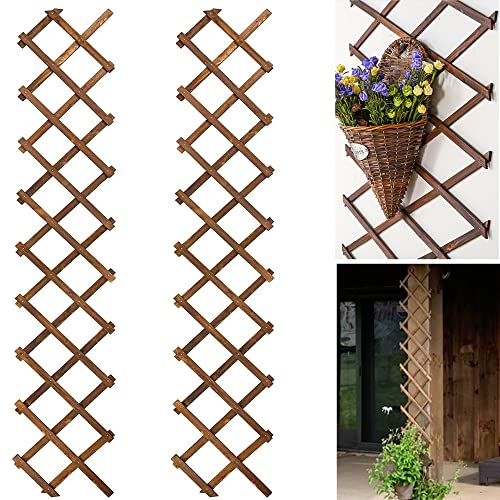
Best for: a low retaining wall or shed corner where two light panels cover more ground than one big one Skip it if: you need a rigid frame that will not flex under a heavy vine
At 2.09 lb for the pair, this is the lightest option here, and it holds the entry price position too. Each panel expands from 17.3 x 10.2 in closed to 12.8 x 67 in fully opened, which is a useful range on a hillside where you often need to fill an odd gap between windows, downspouts or the top of a retaining wall. CJGQ describes the wood as processed by high-temperature carbonisation, giving it hardness and visible grain.
The expandable geometry is the selling point for slope work. You can compress one panel to fit a narrow bay and stretch the other across a longer run, so you buy one product and solve two mounting problems. That flexibility comes at a cost: an accordion lattice is less rigid than a welded frame, and a heavy climber like a mature clematis will pull the joints out of square over time.
The listing does not publish a warranty, and there is no mounting hardware included in the summary. Budget accordingly for exterior screws and washers appropriate to your wall.
Pros:
- Lowest price position in this set
- Two panels for wide or awkward slope walls
- Expands from 17.3 x 10.2 in up to 12.8 x 67 in
- Light 2.09 lb total, easy to hold one-handed on a ladder
Cons:
- Accordion frame flexes under heavy vines
- No stated warranty
- No mounting hardware listed
3. ArdeFentium 60 x 33.3 in Metal Garden Trellis — Best minimal setup
One rigid welded steel panel with screw-fixed joints, designed to go up in a single mounting pass.
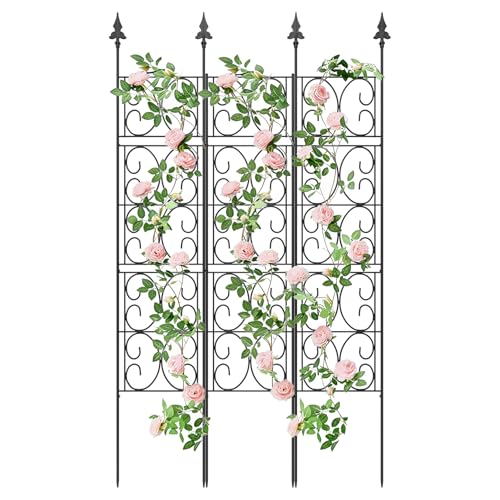
Best for: a single hillside wall where one 60 x 33.3 in panel and a handful of screws finish the job Skip it if: you want to cover a long horizontal run in one shot
ArdeFentium quotes an 8mm thick tube frame and 4mm mesh, which is the beefiest metal specification in this set as claimed on the listing. The panel is a single 60 x 33.3 in unit, so it goes up in one pass rather than the sequenced alignment a two-panel set demands. That matters when you are working off a ladder on a slope, where every extra fastener is another awkward reach.
The brand describes screw-locked joints rather than clip-on connectors, which they say resist loosening over time. The mesh geometry is straight but the listing notes it can be curved, folded or split into separate panels, which gives you options for wrapping a corner where the slope changes plane. The anti-rust coating is standard for the price position, and the finish is black to blend with darker walls.
The panel weight is not published, which is the main data gap here. Assume solid steel of those dimensions is not trivial, and use appropriate masonry or lag fixings rather than drywall anchors. The listing shows a single seller, so lead time is worth checking before you plan installation day.
Pros:
- Single panel, single mounting pass
- 8mm tube and 4mm mesh per the listing
- Screw-fixed joints rather than clips
- Anti-rust coating on black finish
Cons:
- No published weight to plan anchors around
- Only one seller listed
- Straight panel, curving requires field work
4. MyGift Wall Mounted Metal Garden Trellis, Set of 2 — Best upgrade
Two matte-black powder-coated diamond-mesh panels for a modern hardscape wall that can carry the load.

Best for: a modern hardscape wall that can carry 14.1 lb of matte-black steel across two panels Skip it if: your wall is timber siding you would rather not load heavily
Each MyGift panel measures 50 x 24.1 in with rounded corners and a 5mm gauge wire diamond screen, per the listing. The pair weighs 14.1 lb, which is the heaviest option in this set. On a retaining wall of concrete block or brick, that mass sits reassuringly flat; on timber siding it deserves a second thought about stud placement.
The upgrade over the ArdeFentium is finish and versatility. Matte black powder coat on a diamond mesh reads as intentional design rather than raw structure, and the listing states each panel can be mounted horizontally or vertically using the four brackets already attached to each frame. That horizontal option is useful on a stepped retaining wall where you have wider bays than tall ones. Standard mounting hardware is included per the listing, which is not true of most picks here.
Two panels give you flexibility, but they also demand alignment. On an uneven slope wall, aligning two panels to look level takes longer than mounting one. Budget the time and use a long spirit level across both.
Pros:
- Two panels, mountable horizontally or vertically
- Four brackets per frame already attached
- Standard hardware included per listing
- 5mm gauge wire in matte black powder coat
Cons:
- Heaviest in the set at 14.1 lb for the pair
- Only one seller listed
- Alignment across two panels adds install time
5. MyGift Wood Wall Hanging Garden Trellis, Set of 2 — Best premium
Two long wooden lattice panels for a sheltered hillside wall where the trellis is meant to be seen.
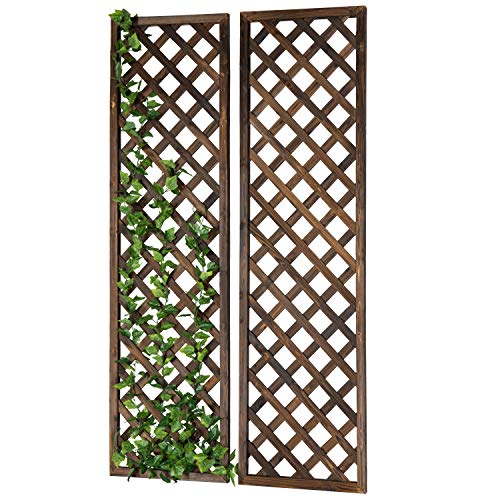
Best for: a sheltered hillside wall where wood tone matters more than raw structural strength Skip it if: the wall gets driving rain and full afternoon sun year-round
Each panel measures 70.9 x 19.7 x 1.18 in, and the pair weighs 5.84 lb. That is a tall, narrow footprint, which suits a slope wall where you have vertical bays between windows or between the retaining wall and the eave. The wood lattice reads warm and traditional, and the listing pitches it for tomatoes, peas and climbing flowers as well as decorative use.
The premium claim rests on look and length, not structure. This is a decorative wood lattice, not a welded steel frame, so choose the wall carefully. A sheltered south wall under an overhang is ideal; a fully exposed north face that gets weeks of wet weather will age it faster than the metal picks.
Hardware is not included, which is the standard caveat for wooden lattice sets. Use rust-resistant exterior screws with a wide washer, spaced to hit at least three points on each panel. A 70.9 in run of wood needs support at the ends and the middle, not just the corners.
Pros:
- Longest wooden panels in the set at 70.9 in
- Natural wood tone for timber or stone walls
- 5.84 lb pair, light enough for one-person handling
- Two panels for stacked slope bays
Cons:
- No mounting hardware included
- No published warranty
- Wood needs a sheltered aspect to age well
What steep-hill buyers should check before ordering
The trellis is only part of the install. On a slope, the wall it mounts to does most of the structural work, so a few checks before you order save a weekend of returns.
- Confirm what the wall is made of. Concrete block, poured concrete, brick, timber siding and cement board all take different fasteners. A trellis designed for four bracket points needs four solid points behind them.
- Measure the wall bay, not just the trellis. Slope-facing walls often have downspouts, hose bibs and settlement cracks that reduce usable width. Chalk the panel outline on the wall before you commit.
- Plan for water paths. Rain running off a hillside above the wall hits the top of the trellis first. Keep the top edge clear of the drip line where you can.
- Think about how you will reach the top. A trellis on a hillside wall is often two feet higher off the ground than the same trellis on flat ground, because you are standing downhill of it. A ladder that sits square on level dirt may not sit square on the slope.
None of the five picks here publishes a wind or load rating, so treat those numbers as unknown and lean on the wall itself for structure. A rigid panel on a solid wall handles a mature climber; a flexible panel on a light wall does not, whatever the plant tag says.
How the five picks compare on frame weight
Weight is the specification that most reliably predicts how a trellis behaves once loaded, so it is worth reading the four published figures side by side.
- The CJGQ wood pair is the lightest published at 2.09 lb for two panels.
- The MyGift wood pair sits in the middle at 5.84 lb.
- The MyGift metal pair is the heaviest published in this set at 14.1 lb for two panels.
- The ArdeFentium metal panel and the Dura-Trel vinyl panel do not publish a weight.
On a masonry wall, weight is a non-issue: anchors handle it, and heavier panels feel more solid. On a timber shed wall, the MyGift metal pair concentrates load on your studs, so spread the fasteners across as many joists as the bracket pattern allows. The two wooden sets are the forgiving choice on lighter walls, at the cost of frame rigidity when a climber matures.
If frame weight is missing from a listing, order a bathroom scale's worth of caution: assume the panel is heavier than it looks, especially on the metal picks, and buy fasteners rated for at least twice the plant's mature weight.
Which wall surface should you mount it to?
The wall decides the trellis more than the plant does, and that is the reversal most guides get wrong. Here is a rough map from the five picks to the walls that suit them.
- Poured concrete or block retaining wall. The Dura-Trel Cambridge or the MyGift metal pair. Both benefit from a rigid substrate, and both have the frame rigidity to justify masonry anchors.
- Painted timber siding on a shed or outbuilding. The CJGQ expandable wooden lattice or the MyGift wood pair. Lighter panels, gentler on the siding, and the wood tone reads correctly next to painted timber.
- Fibre-cement or stucco cladding. The ArdeFentium metal panel. Single-panel installs give you fewer fastener penetrations through cladding, and screw-fixed joints per the listing mean fewer field connections to seal.
- Interior side of a garden wall, sheltered aspect. The MyGift wood pair. Wood ages slowest under an overhang, and the 70.9 in length fits a tall interior bay.
None of these are hard rules, but they will get you closer to the right pick than reading feature bullets in order.
What owning a wall trellis on a slope actually involves
A wall trellis is not a plant-and-forget purchase. On a slope it is even less so, because access is harder. Expect three ongoing tasks.
First, seasonal tightening. Fasteners on any exterior panel loosen over cycles of freeze and thaw, wind and rain. Check the mounting brackets each spring, before the climbers put on serious growth. On the ArdeFentium and both MyGift sets, that means turning a screwdriver at each bracket. On the CJGQ expandable lattice, check the joint pins as well.
Second, cleaning. The Dura-Trel listing states the vinyl wipes clean with a hose and a dry cloth, which is the easiest maintenance profile in this set. Metal panels benefit from a wipe-down to remove tannin stains from wet leaves. Wood panels want a look every autumn for early rot at the fastener points.
Third, plant management. A mature climber pulls harder than a young one. When a plant reaches the top of the panel, it is time to prune or move to a taller structure. A trellis is not a permanent home for a vigorous vine; it is a training frame for a manageable one.
The verdict
The best wall trellis for steep hills splits along one line: how permanent is the install, and how solid is the wall behind it. If you are anchoring into a masonry retaining wall or a solid timber shed and you want the panel up for a decade or more, the Dura-Trel Cambridge is the pick. Its 20-year warranty against fading and cracking is the strongest published durability claim in this set, its 76 x 28 in single panel gives you one clean mounting pass, and vinyl handles the sun-and-moisture cycle that a slope-facing wall throws at it.
If you are working with a shorter budget, or you need to cover two separate bays rather than one continuous wall, the CJGQ expandable wooden lattice is the alternate. Two panels, 12.8 x 67 in each when fully extended, at the entry price position, and 2.09 lb total means you can hold one on a ladder without a second pair of hands. It flexes more than the vinyl or metal picks, so it is not the choice for a heavy climber, but for lighter vines and decorative use it earns its place. The cutoff is the wall itself: rigid substrate goes to the Dura-Trel, awkward or split-bay walls go to the CJGQ.
FAQ
Is a wall trellis actually different from a freestanding one?
A wall trellis is designed to mount flush against a vertical surface with brackets or through-fasteners, so it transfers plant load into the wall rather than the ground. That matters on a steep hill, where ground stakes lose grip in loose slope soil. Every pick here ships with wall-mount geometry: the two MyGift sets include or use bracket-style fixings, and the Dura-Trel and ArdeFentium mount directly through the frame.
Is the Dura-Trel Cambridge worth the mid-range price?
The Dura-Trel Cambridge is worth the mid-range price if you plan to leave it up for years. The 20-year warranty against fading, cracking, peeling and discoloration is the strongest published in this set, and its 76 x 28 in single-panel format simplifies installation on an uneven slope wall. If you want temporary coverage for one growing season, the CJGQ budget pick makes more financial sense.
How does the ArdeFentium metal trellis compare to the MyGift metal set?
The ArdeFentium versus the MyGift metal set comes down to panel count and finish. ArdeFentium ships one 60 x 33.3 in panel with an 8mm tube frame and 4mm mesh per the listing, mounted with screw-fixed joints. MyGift ships two 50 x 24.1 in panels in matte-black powder coat, 14.1 lb for the pair, with four brackets per frame and hardware included. One panel is faster to install; two panels give more layout flexibility.
Will these trellises hold a mature clematis or climbing rose?
A mature clematis or climbing rose puts real load on any wall trellis, especially in wind. The Dura-Trel Cambridge and the MyGift metal pair are the two picks here with the frame rigidity to carry that load, provided the wall behind them is masonry or solid timber. The CJGQ expandable lattice and both wooden picks are better suited to lighter climbers such as sweet peas, morning glory or annual vines that come off at season end.
What is the biggest mistake buyers make choosing a wall trellis for steep hills?
The biggest mistake buyers make is picking the trellis before checking the wall. A rigid panel needs a rigid substrate, and a decorative wood lattice needs a sheltered aspect. Choose the wall first, confirm what it is made of and what fasteners it takes, then match the trellis to that surface. Skip published wind ratings, since none of these publish one, and rely on the wall for structure.
If you are still weighing options, start with the wall. Walk out to the slope, put a hand on the surface you intend to drill into, and ask whether it will hold a fastener in ten years the way it will hold one tomorrow. That answer picks the trellis for you. The Dura-Trel Cambridge is the right default for permanent installs on masonry or solid timber, because its warranty and single-panel geometry match the way slope walls actually get used: one long vertical bay, mounted once, left alone. Everything else in this set is a specialised alternate for a specific wall you already own.